Recovery doesn’t happen automatically. Although your body is naturally designed to repair, restore, and adapt after physical, mental, and emotional stress, the quality of your recovery depends largely on the choices you make each day. Whether you’re recovering from an intense workout, a demanding week at work, an illness, or the everyday stresses of life, your body requires adequate resources. When you optimize recovery, you’re better equipped to perform, think clearly, resist illness, and adapt to future challenges. In this guide, we’ll focus on the practical, evidence-based recovery strategies that help you recoup more effectively.
Fortunately, recovery, is highly trainable. By consistently supporting your body’s natural repair processes through healthy habits, you can restore energy, repair tissues, reduce fatigue, decrease injury risk, regulate hormones, support the immune system, maintain healthy brain function, and promote long-term health. Learn more about Recovery: The Foundation of Health, Fitness, and Performance, where we explain the science behind recovery and why it matters.
Optimizing Recovery: Six Foundations
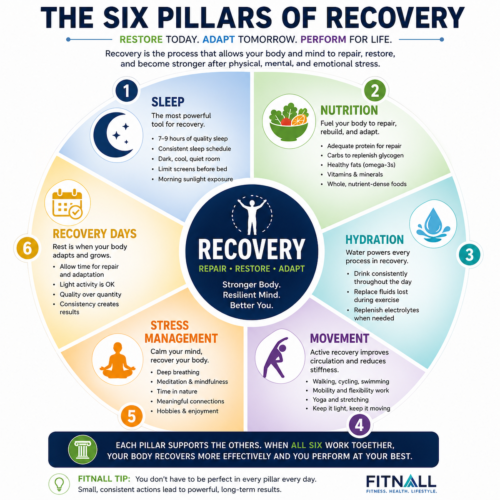
While recovery is influenced by many factors, six daily habits have the greatest impact on your body’s ability to repair, restore, and adapt.
1. Prioritize Quality Sleep
Sleep is the single most important recovery strategy. During sleep, your body repairs tissues, supports muscle protein synthesis, regulates hormones, strengthens the immune system, consolidates memories, and clears metabolic waste from the brain. Deep sleep is also when growth hormone secretion is highest, making it essential for physical recovery and tissue repair.
Poor sleep, on the other hand, can impair strength, endurance, reaction time, cognitive performance, appetite regulation, and immune function while increasing the risk of illness and injury.
You can optimize recovery by practicing good sleep hygiene. For example, aiming for 7–9 hours of sleep, maintaining a consistent sleep schedule, limiting screen exposure before bedtime, and keeping your bedroom cool, dark, and quiet can help you to get a better night’s sleep.
2. Fuel Recovery Through Nutrition
Your body can’t repair when it doesn’t have the nutrients to rebuild. Nutrition can optimize recovery by providing the building blocks your body needs to repair tissues, replenish energy stores, regulate inflammation, and support the many biological processes involved in recovery.
Following exercise, your body enters a period of active repair. Meal timing and strategic macronutrient fueling with high-quality protein to support tissue repair, carbohydrates to replenish glycogen stores after exercise, and healthy fats are essential for restoring function and preparing for future physical and mental demands.
Nutritional recovery strategies include:
- Anti-inflammatory foods and compounds
- Omega-3 fatty acids
- Polyphenols such as tart cherry, curcumin, and pomegranate
- Branched-chain amino acids (BCAAs) – leucine, isoleucine, valine
- Creatine monohydrate
- Vitamins and minerals such as magnesium, potassium, calcium, zinc, vitamin D, and vitamin C (Calcium- Magnesium formula, mineral complex).
Prioritizing a nutrient-rich diet that provides the essential components needed for recovery is essential for reducing muscle soreness, supporting the body’s response to exercise-induced inflammation, restoring function, and preparing for future physical and mental demands.
3. Stay Hydrated to Optimize Recovery
Staying properly hydrated is one of the simplest ways you can optimize recovery. Water plays a vital role in regulating body temperature, transporting nutrients to your cells, lubricating your joints, removing waste products, and supporting healthy muscle contractions, brain function, and energy production.
Even mild dehydration can reduce physical performance, impair concentration, increase fatigue, and slow your body’s natural recovery processes.
Make hydration a daily habit, not something you think about only after a workout. Drink water consistently throughout the day, and replace the fluids and electrolytes you lose during prolonged or intense exercise. For practical tips on meeting your hydration needs, read this Hydration Guide.
4. Keep Moving
When you think of recovery, you may picture lying on the couch or taking a complete day off. While rest certainly has its place, recovery doesn’t always mean doing nothing. In many cases, gentle movement is a recovery strategy that can actually help your body.
Light physical activity increases circulation, helping deliver oxygen and nutrients to your muscles while supporting the removal of metabolic waste products. It can also reduce stiffness, maintain joint mobility, and improve flexibility without placing significant additional stress on your body. Rather than leaving you feeling drained, the right amount of movement can leave you feeling refreshed and ready for your next workout.
You optimize recovery by keeping the intensity low. Your goal isn’t to improve fitness during these sessions; it’s to help your body repair, restore, and prepare for future activity. Active recovery supports long-term movement quality, reduces soreness, and improves your body’s ability to adapt over time.
Examples of active recovery include yoga, walking, easy cycling, stretching, swimming, and mobility exercises.
FITNALL Tip: Listen to your body. If you’re feeling stiff or mildly sore, a light walk or mobility session may help you feel better than complete inactivity. However, if you’re exhausted, sick, or recovering from an injury, your body may benefit more from additional rest. The best recovery strategy is the one that matches what your body needs that day.
5. Manage Stress
While exercise places stress on your body, it’s far from the only source. Every deadline, financial worry, family responsibility, difficult conversation, poor night’s sleep, or emotionally challenging situation also draws from your body’s recovery capacity. When stress becomes chronic stress, it can interfere with sleep, increase inflammation, disrupt hormone balance, weaken your immune system, and reduce your ability to recover—not only from exercise but from the demands of everyday life.
Helpful recovery strategies include mindfulness, breathing exercises, spending time in nature, journaling, social connection, enjoyable hobbies, and techniques that improve vagal tone. Optimizing recovery means supporting not only your body but also your mind.
6. Respect Recovery Days
It’s easy to feel like taking a day off means you’re losing progress, but the opposite is true. Recovery days are an essential part of a well-designed program because they give your body the time it needs to repair, rebuild, and adapt.
During a recovery day, your muscles repair microscopic damage, connective tissues recover, your nervous system recharges, and energy stores are replenished. These processes help reduce fatigue, lower your risk of injury, and prepare you for your next workout. Without adequate recovery, your body has fewer resources available to adapt, making consistent progress more difficult.
A recovery day may involve complete rest or light activities. The key is to reduce the physical and mental demands on your body. Remember, your results aren’t determined by how hard you train on any single day; they’re determined by how consistently you balance challenge with recovery over time.
FITNALL Tip: Don’t view recovery days as “days off.” Think of them as adaptation days, the time when your body transforms yesterday’s effort into tomorrow’s strength, energy, and resilience.
Recovery Strategies: What Actually Works?
Recovery products are everywhere, but not every tool has the same level of scientific support.
Strong Scientific Support
The greatest recovery strategies are the basics: adequate sleep, proper nutrition, hydration, appropriate recovery days, stress management, and movement. Master these before investing in expensive gadgets or supplements.
Moderate Scientific Support
Research suggests that stretching, massage therapy, massage devices, compression garments, foam rolling, and sauna are strategies that optimize recovery.
Cold water immersion and ice baths can reduce soreness and improve comfort after intense exercise or competition. However, regular use immediately after strength training may reduce some of the muscle-building adaptations associated with resistance exercise. If maximizing muscle growth is your goal, it may be best to reserve cold therapy for periods of heavy training, competition, or rest days rather than after every workout.
These tools may help reduce muscle soreness, improve flexibility, promote circulation, or enhance comfort, but they work best alongside foundational recovery habits, not in place of them.
Emerging Evidence
Some recovery modalities such as red light therapy and cryotherapy show promise. While early studies are encouraging, evidence is still evolving, and these approaches should be viewed as complementary rather than essential.
Optimize Recovery: Common Mistakes to Avoid
You may be putting significant effort into your workouts, nutrition, and overall health without realizing that a few everyday habits are limiting your recovery. Fortunately, many of the most common recovery mistakes are also the easiest to correct.
Avoid these common pitfalls:
- Treating soreness as a sign of progress. Feeling sore doesn’t necessarily mean you’ve had a better workout or that you’ll see better results. Consistent progress comes from adaptation, not prolonged soreness.
- Not getting enough sleep. Even the best training program can’t compensate for chronic sleep deprivation.
- Eating too little or not consuming enough protein. Your body needs energy and nutrients to repair tissues and support recovery.
- Training intensely every day. More exercise isn’t always better. Without adequate recovery, your body has less opportunity to adapt and improve.
- Overtraining: Persistent fatigue, declining athletic performance, and recurring injuries are signs that you may be overdoing it. Learn the warning signs, causes, prevention, and recovery strategies related to overtraining.
- Ignoring chronic stress. Mental and emotional stress compete for the same recovery resources your body uses after exercise.
- Relying on caffeine instead of rest. Stimulants may temporarily mask fatigue, but they don’t replace the restorative benefits of sleep and recovery.
- Using alcohol to relax regularly. Alcohol can interfere with sleep quality, hydration, muscle recovery, and many of the body’s natural repair processes.
- Looking for a supplement instead of improving your habits. While some supplements may support recovery, they can’t replace the fundamentals of quality sleep, balanced nutrition, hydration, stress management, and appropriate recovery days.
Recovery isn’t built on quick fixes; it’s built on small, healthy behaviors practiced consistently over time.
Conclusion
Recovery isn’t something you earn after working hard; it’s an essential part of the work itself. Every night’s sleep, balanced meal, glass of water, walk, relaxation session, and recovery day give your body another opportunity to repair, restore, and adapt. While no single strategy will optimize recovery on its own, consistently supporting your body’s natural recovery processes can have a profound impact on your health, performance, and longevity. The goal isn’t perfect recovery. It’s building sustainable habits that help your body recover efficiently, adapt to life’s challenges, and perform at its best for years to come.
Recovery isn’t a separate pillar of health; it’s the result of foundational pillars working together. The FITNALL Method recognizes that recovery depends on more than muscles. Appropriate exercise provides the stimulus for improvement, but internal health, nutrition, mindset, stress adaptation, longevity habits, and daily lifestyle choices determine how effectively your body responds. When these areas are balanced, recovery becomes more efficient, allowing you to be more energized, adapt more effectively to challenges, and build greater resilience over time.
Frequently Asked Questions
While you can’t eliminate your body’s natural healing processes, quality sleep, proper nutrition, hydration, active recovery, and stress management can help optimize recovery.
Stretching may improve flexibility and reduce feelings of stiffness, pain, and muscle soreness. It offers great results when combined with the six foundations of recovery.
They can be helpful for reducing soreness after intense exercise or competition, but they may not be ideal immediately after strength training if muscle growth is your primary goal.
Yes. Walking is one of the simplest and most effective forms of active recovery because it promotes circulation without placing excessive stress on the body.
Supplements may be helpful additions to your recovery strategy, but they should never replace the fundamentals of recovery: sleep, nutrition, hydration, movement, and stress management.
To a Fitter Healthier You,
Mind-Body Optimization Specialist
About the Author
Adriana Albritton is a Mind-Body Optimization Specialist and founder of FitnAll Coaching. She developed the FITNALL Method, a holistic framework that integrates fitness, internal health, thought patterns, nutrition, adaptation, longevity, and lifestyle habits to support sustainable fat loss and long-term wellness. Adriana is the author of 28 Days to a New Life: A Holistic Program to Get Fit, Delay Aging, and Enhance Your Mindset. She speaks and writes about holistic performance, longevity, and the integration of mind and body for optimal health.