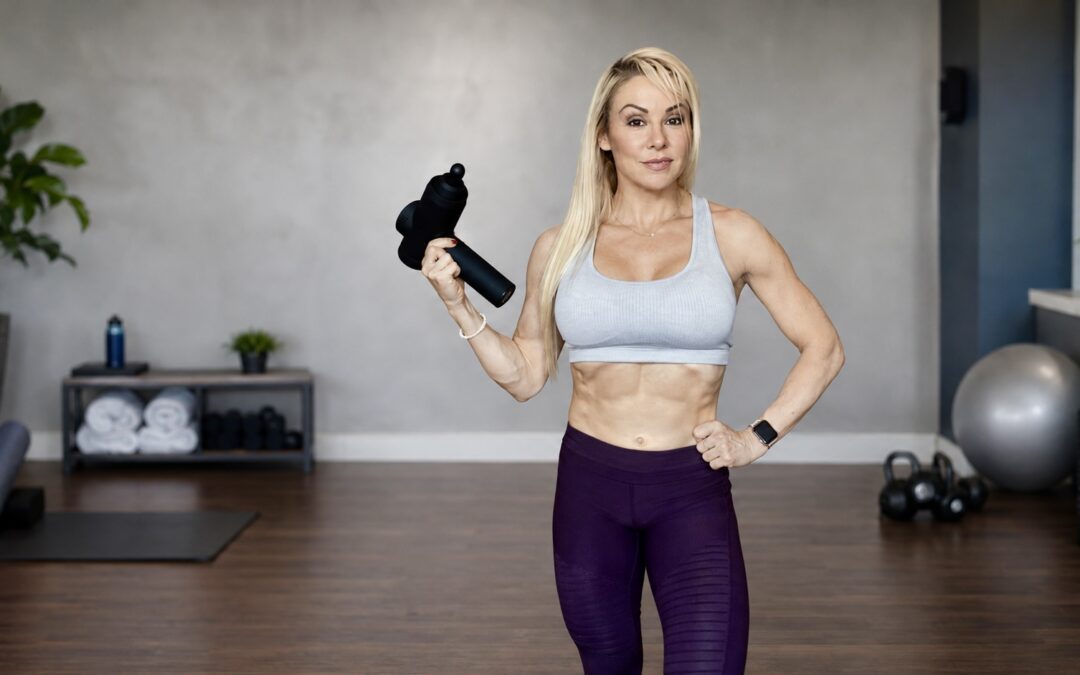
Massage guns have become popular among athletes, fitness enthusiasts, physical therapists, and anyone looking for a convenient way to manage tight or sore muscles. But do massage guns really work? The short answer is: Massage guns may temporarily improve flexibility and range of motion while helping reduce muscle soreness, stiffness, and perceived pain. However, they do not replace proper recovery or hands-on care from a qualified professional. In this article, you’ll learn relevant massage gun benefits, as well as how, when, and where to use a massage gun.
What Is a Massage Gun?
Self‐myofascial release (SMR) is the idea of using a tool for self-massage. Common SMR tools include foam rollers, roller sticks, and massage guns. A massage gun is a handheld device that delivers rapid pulses of pressure into the body’s soft tissues. This technique is commonly called percussive therapy or percussion massage.
Unlike a foam roller, which uses sustained pressure over a larger area, a massage gun delivers repeated mechanical stimulation to a more targeted muscle group. Most devices offer multiple speeds and interchangeable attachments for different muscles and comfort levels.
Massage guns are often used as part of:
- A pre-workout warm-up
- A post-workout recovery routine
- A mobility session
- General muscle-relaxation practices
- Self-myofascial release
Do Massage Guns Work?
Research on massage guns is promising, but it is still developing. Most studies are small, use different treatment protocols, and examine short-term rather than long-term results. A 2023 systematic review found that percussive therapy may support temporary improvements in flexibility, strength, and experiences of musculoskeletal pain.
Another review concluded that massage guns appear most useful for improving short-term range of motion, flexibility, and certain recovery outcomes, but their effects on strength, agility, balance, and explosive performance are less consistent.
Therefore, massage guns should be viewed as a supportive mobility and recovery tool, not a cure or a substitute for medical treatment.
Massage Gun Benefits
As you may know, the benefits of massages are numerous – pain and inflammation reduction, decreased cortisol levels, improved circulation, and mitochondrial regeneration – and the benefits of massage guns can overlap. Let’s delve into evidence-based massage gun benefits.
1. May Increase Range of Motion
One of the better-supported massage gun benefits is a temporary improvement in joint range of motion.
In one study, five minutes of percussive treatment applied to the calf muscles increased ankle range of motion without reducing muscle strength. Another study reported increased hamstring range of motion following a short percussive therapy session.
This may make a massage gun useful before mobility work or exercise, especially when a muscle feels stiff or restricted.
2. May Reduce Muscle Soreness
Percussive therapy may help decrease the perception of post-exercise soreness, including delayed-onset muscle soreness, or DOMS.
The rapid stimulation can temporarily alter how the nervous system processes discomfort while making the treated area feel less tense. This does not necessarily mean that the device is repairing muscle tissue faster, but feeling less sore may make gentle movement more comfortable.
3. May Relieve Muscle Tension and Stiffness
Another massage gun benefit is muscle tension and stiffness relief. Applying light percussive pressure to a muscle may help it feel more relaxed. This can be especially helpful after resistance training, prolonged sitting, repetitive activity, or a stressful day.
A massage gun may also complement mobility exercises when muscle tension makes movement uncomfortable.
4. May Temporarily Reduce Perceived Pain
Studies suggest that repeated percussive therapy treatments may reduce some experiences of musculoskeletal pain. The benefit may result partly from sensory stimulation that temporarily changes pain perception.
A massage gun can be appropriate for ordinary muscular tightness, but it should not be used to self-treat unexplained, severe, persistent, or worsening pain.
5. Provides Convenient Self-Massage
A valuable massage gun benefit is that it promotes self-reliance. Professional massage can be valuable, but regular appointments require time and money. A massage gun offers a convenient way to apply self-massage at home, at the gym, or while traveling.
It also allows you to control the treatment’s location, duration, speed, and intensity.
6. May Promote Relaxation
Gentle percussive massage can be soothing and may help reduce physical tension. Using a low setting while breathing slowly can be incorporated into an evening relaxation or post-workout recovery routine. However, evidence for massage guns specifically treating anxiety or producing long-term stress reduction remains limited.
How to Use a Massage Gun Correctly
Using more speed or pressure does not necessarily produce better results. Start conservatively and let the device provide the force.
- Choose a soft attachment. A round foam or cushioned attachment is appropriate for most large muscles.
- Turn the device on before touching the body. This prevents a sudden, jarring impact against the skin.
- Start at the lowest speed. Increase the setting only if the treatment remains comfortable.
- Relax the targeted muscle. Avoid flexing or contracting it while applying the device.
- Glide the massage gun over the muscle. Keep it moving instead of holding it over one small spot.
- Use light pressure. You should not need to force the device deeply into the tissue.
- Spend approximately 30 seconds to two minutes on a muscle group. Stop sooner if the area becomes painful, numb, irritated, or unusually sensitive.
A massage gun session should feel stimulating or soothing, not sharp, electric, or intensely painful.
Massage Gun Before or After a Workout?
You can use a massage gun at either time, but the technique and goal should differ.
Before Exercise
Use a massage gun briefly to stimulate the muscles you plan to train.
- Select a low or moderate setting.
- Glide over each target muscle for approximately 30–60 seconds.
- Keep the device moving.
- Follow the treatment with an active warm-up and sport-specific movements.
Do not rely on a massage gun as your entire warm-up. It does not adequately raise your core temperature or prepare your joints, nervous system, and movement patterns for exercise.
Extended or aggressive treatment immediately before explosive activity may also be counterproductive. Research reviews recommend caution with longer massage-gun sessions performed within five minutes of strength or power-based exercise.
After Exercise
After training, use a gentle setting to address muscles that feel tense or sore.
- Apply the device for approximately one to two minutes per muscle group.
- Use light pressure.
- Avoid areas that are acutely injured or excessively inflamed.
- Combine the treatment with hydration, good nutrition, sleep, and active recovery.
Massage guns may help you feel better after exercise, but they cannot replace the biological recovery provided by adequate sleep and nutrition.
Which Massage Gun Attachment Should You Use?
| Attachment | Best used for | Important note |
|---|---|---|
| Large round head | Glutes, quadriceps, hamstrings, calves and back muscles | Best general-purpose option |
| Flat head | Larger muscle groups and gentle full-body use | Distributes pressure across a wider area |
| Cushioned head | Tender or sensitive muscles | Start here when you are sore |
| Fork head | Muscles running along either side of a structure | Never place it directly over the spine |
| Bullet head | Small, specific muscular areas | Use cautiously; concentrated pressure can be intense |
Attachment designs vary by manufacturer. Follow the instructions supplied with your device and begin with the softest option.
Where Can You Safely Use a Massage Gun?
Massage guns are generally intended for larger, fleshy muscle groups, including the:
- Glutes
- Quadriceps
- Hamstrings
- Calves
- Upper back muscles
- Shoulders
- Biceps
- Triceps
- Forearms
Use extra caution when treating small or sensitive areas.
Where Should You Not Use a Massage Gun?
Never use a massage gun directly over:
- The front, sides, or back of the neck
- The head or face
- The spine or other bones
- The front of the throat
- The chest, abdomen, or groin
- Joints such as the knees, elbows, or ankles
- Prominent blood vessels
- Varicose veins
- Bruises, rashes, wounds, or broken skin
- A suspected blood clot
- A fracture or stress fracture
- A recent surgical site
- Areas that are numb or have reduced sensation
- Acutely torn, sprained, or inflamed tissue
The University of Utah specifically advises avoiding bony prominences, the neck, injured skin, and the groin because sensitive tissues, blood vessels, nerves, tendons, and bursae may be affected.
Who Should Ask a Healthcare Professional First?
Consult a physician or physical therapist before using a massage gun if you:
- Take blood-thinning medication
- Have a bleeding or blood-clotting disorder
- Have or may have deep vein thrombosis
- Have osteoporosis or low bone density
- Have peripheral neuropathy or reduced sensation
- Have vascular disease or circulation problems
- Recently had surgery
- Are recovering from a significant injury
- Have cancer in the area being treated
- Are pregnant and want to use the device near the abdomen, lower back, or pelvis
- Have a medical condition that affects your muscles, nerves, bones, kidneys, or blood vessels
Stop immediately if massage-gun use causes sharp pain, numbness, tingling, pronounced bruising, swelling, dizziness, weakness, or worsening symptoms.
Common Massage Gun Mistakes
In order to enjoy all massage guns benefits, you should avoid these common errors:
- Starting on the highest setting
- Pushing forcefully into the body
- Holding the device over one spot for too long
- Using it directly over bones or joints
- Treating a fresh injury
- Continuing when the treatment hurts
- Assuming more treatment creates faster recovery
- Using it to mask pain so you can continue exercising
- Replacing a proper warm-up or medical evaluation with the device
The purpose is to support comfortable movement—not to “beat” a tight or painful muscle into submission.
How to Choose a Massage Gun
When comparing massage guns, consider adjustable speed and intensity, comfortable weight and grip, noise level, battery life, soft and firm attachment options, stall force (how easily the motor stops under pressure), amplitude (how far the attachment moves), automatic shutoff, warranty, and customer support.
A more powerful or expensive device is not automatically better. For most people, comfort, control, usability, and lower-speed options matter more than maximum force.
How to Use a Massage Gun Tutorial
My Experience With a Massage Gun
I have used the OPOVE M3 Pro Max as part of my personal mobility and recovery routine. I appreciate its portability, adjustable settings, interchangeable attachments, and ability to target muscles when scheduling a professional massage is not practical.
Regardless of the model you choose, proper technique matters more than applying intense pressure.
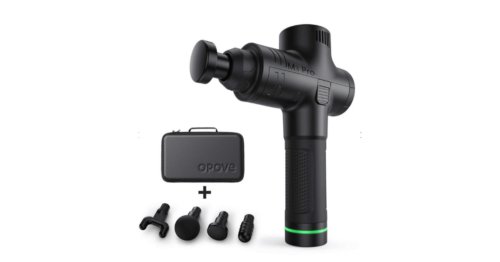
If you are ready to start using a massage gun, check out the following discounts and coupons for the OPOVE M3 Pro Max Massage Gun.
The Bottom Line
Massage gun benefits include improved flexibility and range of motion, and reduced perceived muscle soreness, stiffness, and pain. They are portable, convenient, and easy to incorporate into a warm-up, mobility session, or recovery routine.
However, massage guns are not a substitute for exercise, sleep, nutrition, physical therapy, or medical care. Use light pressure, remain on the muscles, avoid vulnerable areas, and stop if the treatment produces pain or unusual symptoms.
Frequently Asked Questions
For most areas, start with 30 seconds and limit treatment to approximately two minutes per muscle group. Longer sessions are not necessarily more effective and may cause irritation or bruising.
Some people tolerate gentle daily use, but the correct frequency depends on intensity, duration, health status, and tissue sensitivity. Avoid repeatedly treating an area that remains bruised, tender, inflamed, or painful.
No. Mild pressure or temporary tenderness may occur, but sharp, burning, electric, or escalating pain is a signal to stop.
No. Lactate is naturally cleared and reused by the body, typically within a relatively short period after exercise. The soreness experienced one or two days later is not caused by trapped lactic acid.
You can gently treat the muscles on either side of the lower spine, provided you have no contraindications. Do not apply the device directly over the vertebrae, kidneys, abdomen, or an area producing radiating or unexplained pain.
To a Fiiter Healthier You,
Adriana Albritton
Mind-Body Optimization Specialist
About the Author
Adriana Albritton is a Mind-Body Optimization Specialist and founder of FitnAll Coaching. She developed the FITNALL Method, a holistic framework that integrates fitness, internal health, thought patterns, nutrition, adaptation, longevity, and lifestyle habits to support sustainable fat loss and long-term wellness. Adriana is the author of 28 Days to a New Life: A Holistic Program to Get Fit, Delay Aging, and Enhance Your Mindset. She speaks and writes about holistic performance, longevity, and the integration of mind and body for optimal health.
Last updated August 25, 2026
References
- The Effects of Massage Guns on Performance and Recovery: A Literature Review
- Systematic Review of Percussive Therapy, Musculoskeletal Performance and Pain
- Acute Effects of Percussive Massage on Range of Motion and Performance
- Percussive Therapy and Hamstring Range of Motion
- University of Utah: Using Massage Guns Safely