

Millions of people struggle with chronic stress, anxiety, poor sleep, digestive issues, and emotional exhaustion without realizing that many of these problems are connected by one powerful system: the vagus nerve. Learning how to improve vagal tone naturally can help your body recover from stress more efficiently, regulate emotions, support heart health, improve digestion, and build long-term resilience. The good news is that vagal tone can be strengthened through simple daily habits. In this guide, you’ll learn what the vagus nerve and vagal tone are, why they matter, and the most effective vagus nerve exercises to improve vagal tone naturally.
All about the Vagus Nerve & Vagal Tone
What Is the Vagus Nerve?
The vagus nerve is the tenth cranial nerve (cranial nerve X), the longest and one of the most important in your body. Its name comes from the Latin word vagus, meaning “wandering,” because it travels from your brainstem through your neck and into your chest and abdomen, connecting with many of your major organs along the way.
As the primary nerve of the parasympathetic nervous system, the vagus nerve helps regulate many automatic bodily functions that keep you healthy and balanced. It serves as a communication highway between your brain and organs such as your heart, lungs, digestive tract, liver, and other parts of your body, constantly sending information back and forth.
The vagus nerve plays a vital role in regulating:
- Heart rate and blood pressure
- Breathing patterns
- Digestion and gut function
- Swallowing and speech
- Immune system activity
- Inflammation
- Mood and emotional regulation
- Stress recovery
- Sleep quality
In fact, approximately 80% of the nerve fibers in the vagus nerve carry information from your body to your brain, allowing your brain to continuously monitor what’s happening inside your organs. This constant feedback influences everything from how hungry you feel to how safe or threatened your nervous system perceives your environment to be.
Because of its widespread influence throughout the body, the vagus nerve is often considered one of the most important components of the mind-body connection.
Vagal Tone and Why It Matters
While the vagus nerve is the physical structure, vagal tone refers to how well that nerve is functioning. Think of it like muscle tone: having a muscle doesn’t necessarily mean it’s strong or conditioned. Similarly, everyone has a vagus nerve, but not everyone has healthy vagal tone.
Vagal tone describes your vagus nerve’s ability to activate the parasympathetic nervous system, often called your body’s “rest-and-digest” mode. The stronger your vagal tone, the more efficiently your body can shift from a state of stress to one of relaxation and recovery. In simple terms, vagal tone is a measure of your nervous system’s flexibility and resilience.
When vagal tone is strong, your body can:
- Shift out of stress mode quickly
- Regulate emotions more effectively
- Maintain stable heart rate and digestion
- Recover faster from physical and psychological stress
- Maintain a higher heart rate variability (HRV)—a key indicator of a flexible, resilient nervous system and overall autonomic health.
When vagal tone is low, the opposite happens:
- You stay stuck in fight-or-flight
- Anxiety, chronic stress, inflammation, irritability, and overwhelm increase
- Sleep, digestion, and recovery suffer
- Research shows that low vagal tone is associated with impaired recovery of cardiovascular, endocrine, and immune markers
The good news is that, much like a muscle, your vagal tone can be strengthened through consistent vagus nerve exercises.
The Science Behind Vagal Tone
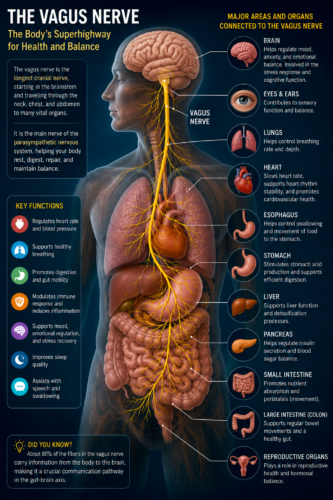
The vagus nerve plays a central role in regulating:
- Heart rate
- Blood pressure
- Digestion
- Inflammation
- Breathing
- Immune function
- Emotional regulation
- Recovery from stress
Researchers often measure vagal tone indirectly through heart rate variability (HRV)—the variation in time between heartbeats. Generally, a higher HRV indicates stronger vagal activity and greater adaptability to stress. Researchers often assess cardiac vagal tone by measuring heart rate variability (HRV). While HRV primarily reflects the vagus nerve’s influence on the heart, it is commonly used as an indirect indicator of overall vagal tone and autonomic nervous system function.
The vagus nerve also activates the cholinergic anti-inflammatory pathway, helping regulate excessive inflammation throughout the body. In addition, it influences neurotransmitters such as GABA, serotonin, dopamine, and acetylcholine, all of which affect mood, relaxation, and cognitive function.
Much of our understanding of vagal function has been influenced by Polyvagal Theory, developed by Stephen Porges. The theory proposes that the nervous system constantly evaluates whether our environment is safe or threatening, shaping emotional responses, social engagement, and stress regulation.
Signs of Low Vagal Tone
You don’t need a specialized medical test to recognize that your vagal tone may be lower than optimal. You have low vagal tone if your nervous system struggles to shift out of “fight-or-flight” mode.
Here are signs of low vagal tone:
- Feeling chronically stressed or constantly on edge
- Reacting more intensely to everyday challenges
- Emotionally shutting down
- Experiencing digestive issues like bloating or IBS-like symptoms
- Having persistent fatigue or burnout
- Getting sick often
- Dealing with ongoing inflammation
- Breathing in a shallow, rapid pattern rather than taking slow, deep breaths
While these signs don’t necessarily confirm low vagal tone, they may indicate that your autonomic nervous system could benefit from greater support and regulation.
The Emotional Root: Why Vagal Tone Is More Than Physical
Improving your vagal tone isn’t just about practicing breathing exercises or taking cold showers. It’s also about how you think, feel, and respond to the world around you. Your nervous system is constantly scanning your environment for signs of safety or danger, and your emotional patterns play a powerful role in determining whether your body remains in a state of calm or chronic stress.
If you live under constant pressure, suppress your emotions, push yourself to be productive without allowing time for recovery, or feel like you’re always “on,” your nervous system may be overlooking the emotional habits that continually activate your stress response and struggle to fully shift into its restorative rest-and-digest state.
Ask yourself:
- Do you constantly strive for perfection or put excessive pressure on yourself?
- Do you have unresolved emotional pain or trauma that still affects your daily life?
- Do you frequently worry about the future or expect the worst-case scenario?
- Is your inner dialogue often critical, negative, or self-defeating?
- Do you have difficulty saying “no” or tend to put everyone else’s needs before your own?
- Are you driven by a fear of failure, rejection, or disappointing others?
- Do you stay constantly busy and rarely allow yourself time to rest or recover?
- Do you feel guilty when you’re not being productive?
- Do you find it difficult to relax, even when nothing is demanding your attention?
If you answered “yes” to several of these questions, your brain may be receiving continuous signals that you’re not safe, even when there is no real threat. Over time, these thought patterns and behaviors can keep your nervous system in fight-or-flight mode and in a chronic state of stress, making it more difficult for your body to relax, recover, and function optimally.
Strengthening your vagal tone, therefore, involves more than stimulating the vagus nerve; it also means creating a genuine sense of safety within your body and mind. Vagus nerve exercises also include learning to regulate your emotions, challenge unhelpful thought patterns, establish healthy boundaries, process difficult experiences, and practice self-compassion. They teach your nervous system that it doesn’t have to remain on high alert. These c
Benefits of Improving Vagal Tone
Strengthening your vagal tone doesn’t just help you feel calmer; it supports the health and function of your entire body. Because the vagus nerve connects your brain with major organs, improving its function can have widespread physical, mental, and emotional benefits.
Greater Emotional Resilience
A healthy vagus nerve helps you regulate your emotions more effectively. Instead of becoming overwhelmed by stress or reacting impulsively, you’re better able to remain calm, think clearly, and respond thoughtfully to life’s challenges. Over time, this emotional resilience can improve relationships, decision-making, and overall well-being.
Faster Recovery from Stress
Stress is unavoidable, but how quickly you recover from it makes a significant difference. Strong vagal tone enables your body to shift more efficiently from the “fight-or-flight” response into the “rest-and-digest” state. This means your heart rate, breathing, and stress hormone levels return to normal more quickly after a stressful event. Vagus nerve exercises can be part of your stress management toolbox.
Improved Sleep Quality
Your body needs a well-functioning parasympathetic nervous system to relax before sleep. Better vagal tone promotes physical and mental relaxation, making it easier to fall asleep, stay asleep, and wake up feeling refreshed. Restorative sleep also supports memory, mood, hormone balance, and recovery.
Better Digestion and Gut Health
The vagus nerve plays a critical role in digestion by stimulating stomach acid production, digestive enzymes, gut motility, and communication between the brain and gut. Improving vagal tone may help reduce digestive discomfort, support a healthy gut, and promote more efficient digestion and nutrient absorption.
Stronger Immune Function and Reduced Inflammation
The vagus nerve helps regulate the body’s inflammatory response. Healthy vagal function helps prevent excessive inflammation, supports immune system balance, and may contribute to better overall health and resilience against illness.
Greater Mental Clarity and Focus
When your nervous system is constantly in survival mode, it becomes more difficult to concentrate, solve problems, and think creatively. Improving vagal tone helps calm the brain, reduce mental fatigue, and enhance focus, memory, and cognitive performance, allowing you to function at your best both personally and professionally.
Improved Heart Health
One of the most well-established benefits of healthy vagal tone is improved cardiovascular function. Strong vagal activity is associated with higher heart rate variability (HRV), which reflects your body’s ability to adapt to changing physical and emotional demands.
Increased Overall Resilience
Perhaps the greatest benefit of improving vagal tone is that it enhances your resilience and your body’s ability to adapt. Whether you’re dealing with physical exercise, emotional stress, illness, or the demands of everyday life, a well-regulated nervous system helps you recover more efficiently and maintain balance. Rather than remaining stuck in a chronic state of stress, your body becomes more flexible, resilient, and capable of responding to challenges in a healthy way.
12 Proven Ways to Improve Vagal Tone Naturally
Improving your vagal tone is one of the most effective ways to support long-term mind-body health. Within the FITNALL Method, it serves as a foundational component of holistic health, helping you build resilience from the inside out.
Here are 12 powerful vagus nerve exercises:
1. Breathwork (Most Powerful Tool)
Deep breathing is one of the best vagus nerve exercises and the fastest ways to activate it.
- Focus on slow breaths that expand your abdomen rather than your chest. Aim for approximately 5–6 breaths per minute by inhaling for 4–5 seconds and exhaling for 6–8 seconds. Longer exhalations increase parasympathetic activation and may improve heart rate variability
- Practice for 5–10 minutes. Once or twice daily
2. Cold Exposure
Brief exposure to cold is a simple yet effective way to stimulate the vagus nerve and activate your body’s natural relaxation response. When cold water comes into contact with your face or body, it triggers the mammalian dive reflex, a built-in survival mechanism that slows your heart rate, promotes parasympathetic activity, and encourages your body to shift out of “fight-or-flight” mode.
You don’t have to jump into an ice bath to experience benefits. These practices can help:
- Splash cold water on your face for 30–60 seconds
- Finish your regular shower with 30–90 seconds of cold water, or briefly immerse your face in cool water
As your tolerance improves, you can slowly increase the duration while always listening to your body.
3. Humming, Singing, Chanting
The vagus nerve passes through your throat and is connected to the muscles involved in speaking and vocalization. Humming, singing, chanting, or even repeating a calming mantra are great vagus nerve exercises. Creating gentle vibrations stimulates the vagus nerve through the vocal cords, encourages greater parasympathetic activation, and helps calm your nervous system.
- Sing along to your favorite song during your commute, hum while preparing dinner, or practice a few minutes of chanting or deep vocalization
- Aim for about 5–10 minutes each day
4. Meditation & Mindfulness
Meditation is one of the most researched methods for improving nervous system regulation. Regular mindfulness practice decreases activity in the sympathetic nervous system, the body’s stress response, while gradually strengthening the parasympathetic nervous system and improving vagal tone.
- Mindfulness doesn’t require emptying your mind or sitting perfectly still. Simply focusing your attention on your breath, bodily sensations, or the present moment without judgment can help reduce stress and improve emotional regulation
- Even 10–20 minutes of daily meditation has been associated with improvements in heart rate variability (HRV), emotional resilience, concentration, and overall well-being
Over time, meditation teaches your nervous system to recover more quickly from stressful situations rather than remaining stuck in a heightened state of alertness.
5. Yoga & Slow Movement
Yoga combines two powerful vagus nerve exercises: controlled breathing and mindful movement. Together, they help calm the nervous system, reduce muscle tension, and improve communication between the brain and body.
- Gentle styles of yoga—such as restorative yoga, yin yoga, and slow-flow practices—are particularly effective because they encourage relaxation rather than intense physical exertion
- Stretching, tai chi, and qigong can produce similar benefits by promoting slow, deliberate movement synchronized with deep breathing
- Practicing for 20–30 minutes several times per week can help improve flexibility, reduce stress, enhance emotional regulation, and support healthier vagal function
6. Social Connection
Humans are biologically wired for connection. Positive social interactions signal safety to the nervous system, encouraging the vagus nerve to activate the body’s “rest-and-digest” response.
- Simple experiences such as making eye contact, sharing a genuine laugh, giving or receiving a hug, engaging in meaningful conversations, or spending time with trusted family members and friends can all promote a healthier vagal tone
- Supportive relationships have also been linked to lower stress hormone levels, improved immune function, better emotional resilience, and greater overall health
Building strong social connections isn’t just good for your mental health; it directly influences your nervous system.
7. Gut Health Optimization
The vagus nerve forms the primary communication pathway between your brain and your digestive system through what is known as the gut-brain axis. In fact, much of the communication traveling along the vagus nerve actually moves from the gut to the brain rather than the other way around.
Supporting a healthy gut may therefore improve nervous system function and emotional well-being:
- Focus on dietary interventions for boosting your gut health
- Limiting ultra-processed foods, excessive added sugars, and chronic alcohol consumption may further support both gut health and vagal function by reducing inflammation throughout the body
8. Exercise (But Not Overtraining)
Regular physical activity is one of the most effective ways to improve heart rate variability (HRV) and strengthen vagal tone. Moderate aerobic exercise, resistance training, walking, cycling, swimming, and other forms of movement all help your nervous system become more adaptable and resilient over time.
However, more isn’t always better. Excessive training without adequate recovery can keep your body in a prolonged state of physiological stress, temporarily suppressing parasympathetic activity and reducing vagal tone.
- Aim for a balanced exercise program that includes cardiovascular training, strength training, flexibility work, and sufficient recovery days. Listening to your body’s signals and prioritizing rest are just as important as the workouts themselves
9. Gratitude, Positive Emotional States, & Stress Management
Your thoughts and emotions continuously influence your nervous system. Chronic worry, anger, fear, and negativity can reinforce a stress response, while cultivating positive emotional states and managing stress in a healthy fashion help keep you out of a fight-or-flight response.
- Practicing gratitude is one of the simplest ways to shift your emotional state. Taking a few minutes each day to write down three things you’re grateful for, reflect on positive experiences, or express appreciation to others can improve mood, reduce stress, and support healthier vagal function over time
- Other positive emotional practices, such as acts of kindness, compassion, forgiveness, optimism, and prayer, also help create a greater sense of safety and emotional balance
- Reducing chronic stress through digital detox periods, massages, journaling, earthing, and other practices helps restore balance between the sympathetic (“fight or flight”) and parasympathetic (“rest and digest”) branches of the autonomic nervous system
10. Gargling
Although it may sound unusual, gargling is a simple vagus nerve exercise that activates muscles in the back of the throat. This gentle stimulation may help strengthen vagal activity over time.
- Try gargling vigorously with water for 30–60 seconds once or twice each day. If your eyes water or you begin to feel a slight gag reflex, you’re likely activating the muscles involved.
While gargling alone won’t dramatically transform your nervous system, it’s an easy, no-cost habit that can complement other vagal tone practices.
11. Nutrients That May Support Vagal Function
While no supplement directly “boosts” vagal tone, several nutrients support nervous system health and healthy neurotransmitter production.
- These include omega-3 fatty acids, magnesium, B vitamins, vitamin D, probiotics, fermented foods, and polyphenol-rich fruits and vegetables
An anti-inflammatory dietary pattern emphasizing whole foods may also support healthy vagal function by improving gut health and reducing systemic inflammation.
12. Quality Sleep
Sleep deprivation significantly increases sympathetic nervous system activity while reducing parasympathetic recovery.
- To support healthy vagal tone, incorporate sleep hygiene habits
The vagus nerve functions best when your body experiences periods of genuine recovery and quality sleep is one of the most powerful ways to improve overall nervous system resilience.
A Simple Daily Vagal Tone Routine
Just as you strengthen your muscles through regular exercise, you can strengthen your vagal tone through consistent vagus nerve exercises. A routine that integrates breathing, movement, mindfulness, emotional regulation, and recovery practices helps optimize your nervous system and support long-term physical and emotional well-being.
Morning (5–10 min):
- Breathwork, prayer, or meditation, + gratitude
Day Time Reset (20 min):
- Social connection or gargling + yoga or exercise, + gut health optimization
Evening (10–15 min):
- Humming, meditation, or stretching, + quality sleep
Optional add-ons:
- Cold exposure
- Digital detox periods
- Journaling
- Thought reframing
Final Takeaway: Train Your Nervous System Like a Muscle
Improving vagal tone naturally isn’t about finding one miracle technique; it’s about consistently supporting your nervous system through healthy daily habits. Vagus nerve exercises like slow breathing, regular movement, nourishing food, quality sleep, mindfulness, meaningful social connection, and emotional regulation work together to strengthen your body’s natural ability to recover from stress.
When you improve vagal tone, you’re not just reducing stress; you’re rewiring how your body experiences life. Lasting health isn’t achieved by addressing the body alone. Sustainable transformation requires optimizing your mindset, emotions, thought patterns, stress management, internal health, and lifestyle habits together. When you strengthen both your physical and emotional resilience, you create a healthier nervous system.
As you strengthen your vagal tone, you’re not just reducing stress; you’re building a healthier, more resilient foundation for long-term physical, mental, and emotional well-being.
Frequently Asked Questions
Yes. Research suggests that consistent lifestyle habits can strengthen vagal tone over time. Vagus nerve exercises such as diaphragmatic breathing, meditation, moderate exercise, cold exposure, social connection, healthy nutrition, quality sleep, and stress management all stimulate the vagus nerve and enhance parasympathetic activity.
Some techniques, such as slow breathing or humming, can activate the vagus nerve within minutes and produce immediate feelings of relaxation. Long-term improvements in vagal tone generally develop over weeks to months through consistent daily practice.
Low vagal tone doesn’t directly cause anxiety, but it reduces your body’s ability to recover from stress. This can contribute to prolonged activation of the sympathetic nervous system (“fight or flight”), making anxiety symptoms more persistent and recovery more difficult.
Yes. Moderate aerobic exercise and regular physical activity can improve heart rate variability and parasympathetic function. However, excessive training without adequate recovery may temporarily suppress vagal tone.
A diet rich in organic vegetables, fruits, omega-3 fatty acids, fermented foods, fiber, magnesium, and anti-inflammatory nutrients supports gut health and may indirectly improve vagal function.
Yes. Slow diaphragmatic breathing with extended exhalations is one of the most effective natural ways to activate the vagus nerve and promote relaxation.
No. Heart rate variability (HRV) is a commonly used marker of autonomic nervous system function and is often used as an indirect measure of vagal tone, but they are not identical.
Vagus nerve exercises such as slow deep breathing, splashing cold water on your face, humming, singing, gargling, and mindfulness meditation are among the fastest ways to stimulate vagal activity and encourage a relaxation response.
To a Fitter Healthier You,
Mind-Body Optimization Specialist
About the Author
Adriana Albritton is a Mind-Body Optimization Specialist and founder of FitnAll Coaching. She developed the FITNALL Method, a holistic framework that integrates fitness, internal health, thought patterns, nutrition, adaptation, longevity, and lifestyle habits to support sustainable fat loss and long-term wellness. Adriana is the author of 28 Days to a New Life: A Holistic Program to Get Fit, Delay Aging, and Enhance Your Mindset. She speaks and writes about holistic performance, longevity, and the integration of mind and body for optimal health.