
Every day, your body is exposed to stress. Some of that stress comes from exercise, but much of it comes from everyday life -work, poor sleep, emotional challenges, illness, environmental exposures- and the countless physical and mental demands placed on your body. Fortunately, your body is remarkably designed to respond. Through a process known as recovery, it continuously repairs damaged tissues, restores energy, regulates hormones, strengthens the immune system, balances the nervous system, and adapts to become stronger and more resilient. Whether your goal is improving your fitness, enhancing athletic performance, maintaining your health, or simply feeling your best each day, the importance of recovery can’t be overstated. This article explores the science behind recovery, why it matters, and how it serves as the foundation for better health, fitness, and performance.
What Is Recovery, Really?
Recovery is the process by which your body and mind repair, restore, and adapt after experiencing physical, mental, or emotional stress. Although many people associate recovery with taking a day off from the gym, recovery is far more than resting your muscles. It is actually a continuous biological process that allows you to become stronger, healthier, and more resilient.
Recovery begins whenever your body encounters a challenge. That challenge may come from exercise, but it can also result from illness, emotional stress, inadequate sleep, demanding work, environmental exposures, or the normal wear and tear of daily life. Regardless of the source, recovery allows your body to repair damaged tissues, restore energy, regulate hormones, strengthen the immune system, rebalance the nervous system, heal after an injury, adapt to a workout, and prepare for future demands. Without adequate recovery, these adaptive processes become less efficient, reducing your ability to perform, heal, and maintain long-term health.
Every physical, mental, or emotional challenge temporarily disrupts homeostasis—your body’s natural state of internal balance. Exercise may increase energy demands, damage muscle fibers, and deplete glycogen stores, while psychological stress can alter hormone levels, sleep quality, immune function, and nervous system activity. Although these stressors affect the body in different ways, they all require recovery before normal function can be restored.
Recovery restores homeostasis while helping your body become better prepared for future challenges. This process, known as adaptation. It allows your muscles, cardiovascular system, brain, immune system, and metabolism to respond more efficiently the next time they encounter a similar stressor. Over time, these repeated cycles of challenge and recovery improve resilience, performance, and overall health.
The importance of recovery involves far more than muscle repair. Multiple systems work together to restore your body after stress, including:
- Tissue Repair: Recovery repairs the microscopic damage that occurs in muscles, tendons, ligaments, bones, and other tissues after physical activity or injury, helping the body become stronger and more resilient.
- Energy & Glycogen Restoration: Recovery replenishes glycogen stores depleted during physical activity while restoring the energy needed for both physical and mental performance.
- Nervous System Recovery: The brain, spinal cord, and nerves recover from the demands of coordinating movement, producing force, and maintaining focus, helping restore energy, reaction time, and performance.
- Hormonal Balance: Recovery helps regulate hormones involved in muscle growth, metabolism, appetite, stress, and energy production, including growth hormone, testosterone, insulin, and cortisol.
- Immune Recovery: Physical activity, illness, injury, and chronic stress all place demands on the immune system. Recovery helps resolve inflammation, repair tissues, and maintain healthy immune function.
- Brain Recovery: Quality recovery supports memory, learning, decision-making, mood, emotional regulation, and cognitive performance while helping reduce mental fatigue.
Whether you’re recovering from a challenging workout, a demanding week at work, an illness, or the everyday stresses of life, recovery is the process that transforms stress into positive adaptation. The healthier your recovery, the greater your ability to perform, think clearly, resist illness, adapt to future challenges, and maintain long-term health.
To understand why recovery is so essential, it helps to first understand how the body adapts to stress—a process that forms the foundation of every improvement in health and performance.
The Science of Recovery
Every challenge your body encounters sends a message: adapt or fall behind. Whether that challenge comes from exercise, illness, environmental changes, learning a new skill, or the everyday demands of life, recovery is the biological process that allows your body to respond by repairing damage, restoring balance, and becoming more resilient.
Exercise provides one of the clearest examples of adaptation because its effects are easy to observe. The same biological principles, however, influence how your body responds to physical, mental, and emotional stress every day. This process doesn’t happen by chance. It follows a series of physiological events that begin the moment your workout ends.
Homeostasis: The Body’s Internal Balance
Any form of stress temporarily disrupts that balance. Physical activity increases energy demands and challenges muscles, while emotional stress, illness, sleep deprivation, and environmental factors can alter hormone levels, immune function, metabolism, and nervous system activity. Regardless of the source, your body responds by working to restore equilibrium, highlighting the importance of recovery.
During exercise, your muscles consume energy, glycogen stores become depleted, body temperature rises, heart rate and breathing increase, stress hormones are released, and muscle fibers experience microscopic damage. Rather than being harmful, these temporary disruptions serve as signals that tell your body it needs to adapt. Without this challenge, there would be no reason for your body to become stronger or more efficient.
Adaptation: How Your Body Improves
The importance of recovery can be seen in adaptation. Once the challenge has passed, your body begins repairing damaged tissues, restoring energy stores, regulating inflammation, and strengthening the systems that were challenged during your workout. Over time, these repeated cycles of stress followed by recovery lead to measurable improvements in fitness and health.
Depending on the type of training you perform, your body may adapt in several ways:
- Muscular adaptations: Damaged muscle fibers are repaired, leading to increased strength, endurance, and, when supported by proper nutrition and training, muscle growth.
- Cardiovascular adaptations: Your heart becomes more efficient, stroke volume increases, and your muscles develop a greater capacity to deliver and use oxygen.
- Metabolic adaptations: The body improves its ability to store glycogen, utilize carbohydrates and fat for energy, and regulate blood sugar.
- Neurological adaptations: The brain and nervous system become better at recruiting muscle fibers, improving coordination, balance, reaction time, and movement efficiency.
- Cellular adaptations: Cells produce more mitochondria, energy-producing powerhouses, allowing you to perform physical activity with less fatigue.
- Connective tissue adaptations: Tendons, ligaments, bones, and other connective tissues gradually become stronger, helping improve resilience and reduce injury risk.
These adaptations explain why activities that once felt difficult eventually become easier. Your body isn’t simply recovering; it’s preparing itself to better handle similar challenges in the future.
Supercompensation: Recovering Beyond Your Starting Point
One of the best-known examples of adaptation in exercise science is supercompensation.
Immediately after a workout, your performance temporarily declines because your body is fatigued and energy stores have been depleted. During recovery days, your body repairs the damage caused by exercise and restores depleted resources. Given adequate time, nutrition, hydration, and sleep, it doesn’t just return to baseline; it often rebuilds slightly above its previous level.
This temporary improvement is known as supercompensation. By consistently training during this period of improved readiness, you gradually increase strength, endurance, fitness, and overall performance over time. However, supercompensation only occurs when recovery is sufficient. If you train too hard or too frequently without allowing your body enough time to recover, you may interrupt the adaptation process before it is complete.
Why More Isn’t Always Better
Many people assume that pushing harder always produces better results. While appropriate stress is necessary for growth, the body can only adapt when periods of challenge are balanced with adequate recovery. This principle applies not only to exercise but also to work, learning, and other physical or mental demands.
In the context of fitness, progress depends on balancing training stress with recovery capacity. Think of exercise as making a withdrawal from your body’s “adaptation bank account.” The importance of recovery involves replenishing that account and ideally adding a little extra. If withdrawals consistently exceed deposits, the body has fewer resources available for repair and adaptation.
Over time, inadequate recovery can contribute to:
- Persistent fatigue
- Declining performance
- Reduced strength and endurance
- Increased injury risk
- Poor sleep quality
- Mood changes and irritability
- Increased susceptibility to illness
- Plateaus in fitness or weight loss
This doesn’t mean you should avoid challenging workouts. Progressive overload, the gradual increase in training demands, is essential for improvement. The key is pairing progressively greater challenges with enough recovery to allow your body to successfully adapt.
The goal isn’t to avoid stress. It’s to provide your body with the right amount of stress followed by the recovery it needs to emerge stronger than before.
Recovery Capacity
Recovery isn’t determined by your workouts alone. Your ability to adapt depends on your overall recovery capacity, the resources your body has available to repair and restore itself. Sleep, nutrition, hydration, stress levels, age, illness, medications, and overall health influence how quickly and effectively you recover.
Two people can complete the same workout yet recover very differently because their recovery capacity is not the same. It isn’t just about reducing training stress but also about strengthening the body’s ability to adapt. This emphasizes the importance of recovery.
Why Recovery Matters
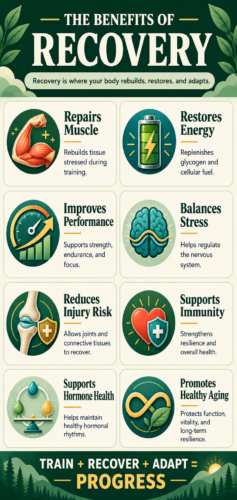
Recovery is far more than taking a day off from exercise. It is the biological process that allows your body to repair, restore, and adapt after physical, mental, and emotional stress. Every day, your body works to heal tissues, regulate hormones, strengthen the immune system, restore energy, and maintain healthy brain function. These processes influence nearly every aspect of your health, from physical performance and metabolism to cognition, resilience, and healthy aging.
Without adequate recovery, your body cannot fully benefit from the effort you put into training, healthy eating, or other lifestyle habits. Every positive adaptation, from building muscle and improving endurance to strengthening your immune system and supporting brain function, depends on giving your body enough time and resources to recover.
Whether your goal is improving athletic performance, losing weight, increasing energy, or promoting healthy aging, recovery is one of the most important investments you can make in your long-term health.
Recovery Supports Muscle Growth
Strength training creates microscopic damage to muscle fibers. Contrary to popular belief, muscles do not grow during your workout; they grow afterward, during recovery.
Following exercise, your body increases muscle protein synthesis, the process of repairing damaged fibers and reinforcing them to better withstand future stress, accentuating the importance of recovery. Along with it, adequate protein intake, quality sleep, and progressive training allow muscles to become stronger and increase in size over time.
Without sufficient recovery, however, the body cannot keep up with repair demands. Instead of building strength, performance may plateau, soreness may persist, and the risk of injury can increase.
Recovery Enhances Fat Loss
Sustainable fat loss depends on more than exercising and dieting. While physical activity and a calorie deficit certainly contribute to energy expenditure, Recovery influences the physical and psychological factors that help you build habits and maintain healthy behaviors over time.
Inadequate recovery can increase physical fatigue, making it harder to stay active throughout the day and maintain workout intensity. It can also create cognitive overload that causes decision fatigue, impeding healthy decision-making. At the same time, improper recovery can contribute to hormonal changes that affect hunger, satiety, and food cravings.
Recovery supports fat loss by helping maintain:
- Consistent training performance
- Healthy appetite regulation
- Stable energy levels
- Insulin sensitivity
- Balanced stress hormone activity
Making healthy food choices, staying physically active, and sustaining the behaviors that support long-term weight management are possible due to the importance of recovery.
Recovery Improves Athletic Performance
Whether you’re a recreational exerciser or a competitive athlete, recovery plays a central role in performance.
Training challenges your muscles, cardiovascular system, and nervous system. Recovery allows each of these systems to adapt, leading to improvements in strength, endurance, speed, power, coordination, balance, and reaction time.
Understanding the importance of recovery benefits anyone who wants to perform at their best whether in sports, work, or everyday life. Recovery also helps maintain training quality by reducing accumulated fatigue, allowing each workout to be performed with greater focus, energy, and intensity.
Recovery Protects Your Brain and Mental Performance
Recovery doesn’t only happen in your muscles; it also occurs in your brain.
Physical activity, work, family responsibilities, and everyday stress all place demands on your nervous system. Quality recovery allows your brain to restore energy, process new information, regulate emotions, and strengthen neural connections involved in learning and memory.
Sleep, stress management, and restorative activities support cognitive functions such as:
- Memory consolidation
- Attention and concentration
- Decision-making
- Learning
- Creativity
- Emotional regulation
Mental recovery is just as important as physical recovery, particularly in today’s fast-paced world where chronic stress and constant stimulation can leave the brain feeling fatigued even when the body appears rested. The importance of recovery can be seen not only in cognitive performance but also in maintaining motivation, emotional resilience, and healthy decision-making.
Recovery Strengthens the Immune System
Physical activity, illness, psychological stress, and inadequate sleep all place demands on the immune system. During recovery, the body repairs damaged tissues, resolves inflammation, and restores immune function.
While regular physical activity is associated with a healthier immune system, overtraining without enough recovery or being constantly stressed increases susceptibility to illness by limiting the body’s ability to repair and defend itself.
Supporting recovery through adequate sleep, balanced nutrition, hydration, and stress management helps maintain a strong and resilient immune system.
Recovery Supports Hormonal Health
Recovery helps maintain the healthy regulation of the hormones responsible for energy production, metabolism, muscle growth, appetite, stress adaptation, and overall well-being.
Quality sleep and adequate recovery contribute to having healthy cortisol, growth hormone, testosterone, insulin, leptin, and ghrelin levels.
When recovery is consistently compromised, hormonal balance may be disrupted, making it more difficult to recover from exercise, regulate appetite, maintain energy levels, and perform at your best.
Recovery Promotes Healthy Aging
As we age, the body’s ability to repair tissues and recover from physical stress gradually declines. Muscle protein synthesis slows, connective tissues require more time to heal, and sleep patterns often change.
Recovery becomes increasingly important for maintaining muscle mass, preserving bone density, supporting cognitive function, reducing chronic inflammation, and maintaining independence throughout life.
Rather than viewing recovery as a sign of slowing down, it should be seen as an essential strategy for staying active, healthy, and resilient for decades to come.
Recovery Supports Sustainable Progress
One of the biggest misconceptions about health is that more effort always leads to better results. In reality, sustainable progress depends on balancing periods of challenge with periods of recovery. Whether you’re exercising, learning a new skill, managing stress, or recovering from illness, your body needs time to repair, restore, and adapt before it can perform at a higher level.
Conclusion
Recovery is much more than taking a break or resting after exercise. It is one of your body’s most important biological processes, a continuous cycle of repair, restoration, and adaptation that supports every aspect of your health.
Every day, your body responds to the physical, mental, and emotional demands placed upon it. Through recovery, damaged tissues are repaired, energy stores are replenished, hormones are regulated, the immune system is strengthened, and the brain processes and adapts to new experiences. These countless behind-the-scenes processes help you become stronger, healthier, and more resilient over time.
Whether your goal is improving your fitness, enhancing athletic performance, maintaining a healthy weight, supporting longevity, or simply feeling your best, recovery is what allows your body to transform stress into positive change. Without it, even the healthiest habits cannot produce their full benefits. Understanding the importance of recovery is the first step. Now, let’s explore how to optimize recovery with science-backed recovery strategies.
Key Takeaways
Recovery influences every system for:
- Muscle growth and repair
- Cardiovascular health
- Brain function and mental performance
- Immune resilience
- Hormonal balance
- Metabolism and body composition
- Healthy aging
- Physical performance and daily energy
No matter your goal, recovery is the process that transforms stress into positive adaptation and long-term progress and health.
To a Fitter Healthier You,
Mind-Body Optimization Specialist
About the Author
Adriana Albritton is a Mind-Body Optimization Specialist and founder of FitnAll Coaching. She developed the FITNALL Method, a holistic framework that integrates fitness, internal health, thought patterns, nutrition, adaptation, longevity, and lifestyle habits to support sustainable fat loss and long-term wellness. Adriana is the author of 28 Days to a New Life: A Holistic Program to Get Fit, Delay Aging, and Enhance Your Mindset. She speaks and writes about holistic performance, longevity, and the integration of mind and body for optimal health.