

Long before modern instruments could measure electrical impulses, brain activity, or heart rhythms, healing traditions described human beings as interconnected systems animated by vital energy. Chinese traditions speak of qi and three dantian, or energy centers. Indian traditions describe prana flowing through a system of chakras, while other cultures developed their own maps of the life force believed to animate the body. Many qi practices can influence measurable aspects of physiology and subjective well-being. Learning to regulate your nervous system, inhabiting your body more fully, processing emotional energy, directing your attention, and using your physical and mental resources more intentionally help to cultivate your vital energy.
What Does It Mean to Cultivate Your Vital Energy
In everyday language, we describe ourselves as energized, drained, grounded, scattered, open, heavy, or inspired. These expressions capture real changes in arousal, mood, attention, muscular tension, motivation, and physical readiness.
Your vital energy influences the quality of your biofield, reflecting the dynamic interplay among your physical vitality, emotional state, thoughts, and overall mind-body coherence. Energy cultivation is then better understood as a coordinated practice. It involves four related capacities:
- Generating energy through sleep, nutrition, movement, breath, sunlight, meaningful activity, and healthy relationships.
- Conserving energy by reducing your shadow, chronic stress, unnecessary tension, overstimulation, and habits that repeatedly deplete you.
- Regulating energy by shifting between activation and recovery according to what the moment requires
- Directing energy by placing attention, intention, breath, and action where they serve you most.
The aim is not to remain calm at all times. A healthy system can mobilize for effort and return to recovery. It can feel emotion without becoming permanently captured by it. It can think deeply without losing contact with the body.
Traditional Energy Maps
Qi, prana, dantian, and chakras belong to traditional philosophical and healing systems. They organize human experience differently from contemporary anatomy and physiology. Qi and Prana refer to life breath, vital energy, or life force that animates our bodies, while dantian and chakras are specific points of energy in the body.
The practices linked to these energy maps, however, often use mechanisms that can be investigated scientifically. Slow breathing can change cardiorespiratory rhythms and heart rate variability. Meditation can train attention and influence the way people perceive internal bodily signals. Gentle coordinated movement can support balance, mobility, relaxation, and body awareness. Visualization can shape attention and emotional state, even when the image being visualized is symbolic.
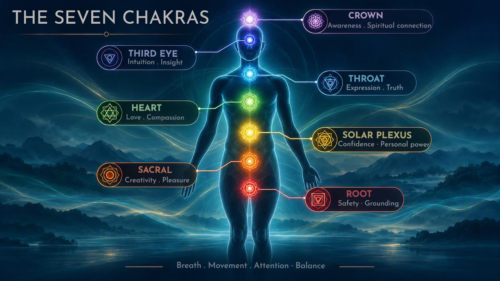
The Seven Chakras
Indian spiritual and yogic traditions describe seven principal chakras, or energy centers, extending from the base of the spine to the crown of the head.
Each chakra is traditionally associated with a different dimension of human experience:
- Root Chakra: Located at the base of the spine; associated with survival, stability, security, and grounding
- Sacral Chakra: Located just below the navel; manages creativity, pleasure, and sexuality
- Solar Plexus Chakra: Located in the stomach area; controls self-esteem, confidence, and personal power
- Heart Chakra: Located in the center of the chest; tied to love, compassion, and emotional balance
- Throat Chakra: Located in the throat; governs communication, truth, and self-expression
- Third Eye Chakra: Located in the center of the forehead; linked to intuition, insight, wisdom, and inner vision
- Crown Chakra: Located at the top of the head; represents spiritual connection, enlightenment, and higher awareness
The Three Dantian
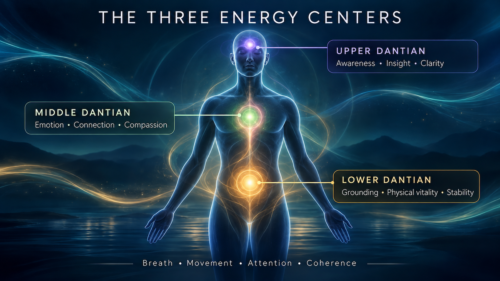
In Chinese tradition, the dantian are described as centers in which qi is gathered, refined, and circulated. Interpretations vary among schools, but the three-center framework offers a simple way to work with the body, emotions, and awareness as parts of one system.
- The Lower Dantian: Located conceptually a few inches below the navel and inward toward the center of the body. It is associated with physical essence, stability, strength, and grounded vitality
- The Middle Dantian: Associated with the chest and heart region. It’s connected with breath, emotion, compassion, the heart, and human connection. It represents the ability to experience feelings without either suppressing them or being overwhelmed by them
- The Upper Dantian: Located in the head; it’s associated with perception, awareness, insight, and spirit. Practices centered here cultivate the ability to observe thoughts, direct attention, imagine possibilities, and recognize patterns without automatically believing every mental event
Why Energy Must Move in Both Directions
Wellness culture often emphasizes raising energy, elevating consciousness, or maintaining a high vibration. This language can become unhelpful when it implies that ordinary emotions are failures or that the goal is to live permanently in an activated, positive state.
A resilient system moves in both directions. Energy rises when you need alertness, courage, creativity, or action. It settles when you need sleep, digestion, repair, emotional processing, or safety. The lower energy center provides stability, the middle allows feeling and connection, and the upper dantian provides perspective. No energy center is superior to the others.
Practices to Cultivate Your Vital Energy
Qi Practices for the Lower Energy Centers
Qi Practices for the lower energy center include martial arts and breathing techniques. Many martial arts and qigong practices begin here because effective movement depends on balance, breath, and connection to the body’s center of mass. Focusing on the lower abdomen can encourage diaphragmatic breathing and increase awareness of posture, pelvic position, and unnecessary muscular bracing.
- Qigong Practices: Qigong cultivates your vital energy through slow, intentional movement, grounded posture, focused attention, and diaphragmatic breathing, helping develop stability, body awareness, and physical vitality.
- Lower-Abdominal Breathing: Place both hands below the navel. Inhale comfortably through the nose and allow the abdomen and lower ribs to expand. Exhale slowly without forcing the breath.
- Grounded Standing: Stand with the feet about hip-width apart, knees soft, spine long, and weight distributed across the whole foot. Notice the support beneath you for one to three minutes.
- Slow Strength: Perform controlled squats, split squats, carries, or other familiar movements while maintaining steady breathing and awareness of your center.
- Walking Meditation: Feel each heel, midfoot, and forefoot meet the ground. Let attention return to your steps whenever the mind wanders.
- Time in Nature: Use sensory contact with the environment—temperature, sound, light, and the ground beneath you—to interrupt mental overactivity.
- Earthing: Allowing your skin to make contact with the Earth’s surface is a good way to cultivate your vital energy. It directs your attention toward the feet and the body’s connection with the ground, promoting a greater sense of stability, presence, and grounded vitality due to the Earth’s healing electrons.
Use qi practices for the lower center when you feel scattered, overstimulated, physically disconnected, or mentally “above” your body. Grounding is not passivity; it creates the stability from which effective action becomes possible.
Qi Practices for the Middle Energy Centers
Emotion is embodied: anxiety may tighten the chest, grief may alter breathing, and affection may soften facial expression and muscle tone. Directing gentle attention toward the heart or chest can help a person notice these patterns. Slow breathing, gratitude, supportive relationships, and accurately naming emotions may help you cultivate your vital energy and regulate your emotions.
- Heart-Focused Meditation: Place a hand over the center of the chest and breathe slowly and comfortably. Imagine the breath moving through the heart area while focusing on a positive emotion, such as love or gratefulness. Heart coherence meditation shifts the focus from purely mental effort to physiological regulation
- Genuine Appreciation: Bring to mind a person, place, animal, or experience that naturally evokes gratitude or care. Let the feeling be subtle rather than performing positivity.
- Chest-Opening Movement: Combine gentle thoracic extension, shoulder circles, or arm sweeps with easy breathing. Avoid aggressive stretching.
- Humming or Extended Exhalation: A soft hum or a slightly longer exhale can slow the breath and create a soothing vibration. Stop if you feel lightheaded.
- Emotion Labeling: Ask, “What am I feeling, and where do I sense it in my body?” Naming an emotion can create space between the feeling and the reaction and help you cultivate your vital energy.
- Healthy Connection: Speak honestly with a trusted person, receive support, or offer attention without immediately trying to fix the other person.
Qi practices that focus on your heart don’t mean abandoning boundaries. Compassion and discernment can coexist. Sometimes the most coherent response is warmth; at other times it is a clear no.
Qi Practices for the Upper Energy Centers
Attention is a limited resource. Constant notifications, multitasking, rumination, and excessive information can fragment it. Qi Practices for the upper energy center, such as meditation and reflection, can reduce unnecessary cognitive switching, increase your awareness, and help attention become more deliberate.
- Focused Attention: Choose the breath, a sound, or a visual point as an anchor. When the mind wanders, notice it and return without self-criticism.
- Open Monitoring: Observe thoughts, sensations, and emotions as changing events rather than commands that must be followed.
- Visualization: Picture yourself moving through an important situation with grounded posture, steady breathing, and clear action. Use imagery to rehearse qualities and results.
- Mental Quiet: Create short periods without audio, screens, or incoming information. Silence gives the mind fewer demands to process.
- Reflective Writing: Ask what you are noticing, what matters now, and whether your current choices support your values.
- Cognitive Reframing: Consciously viewing a challenge from a more constructive perspective can support the upper dantian by interrupting rigid thought patterns and cultivating clarity, insight, and intentional awareness.
Upper-center qi practices are most useful when they remain connected to the lower centers. Insight without grounding can become rumination. Spiritual aspiration without emotional honesty can become avoidance. Clear awareness should bring you more fully into life, not remove you from it.
How to Integrate Energy Cultivation Into Daily Life
Energy is shaped less by occasional peak experiences than by repeated daily inputs. Use the three centers as a brief self-check:
- Lower: Have I slept, eaten, moved, and grounded my body?
- Middle: What am I feeling, and where do I need connection or a boundary?
- Upper: What am I giving my attention to, and does it reflect what matters?
The sequence matters. When you feel anxious or mentally overloaded, beginning with complex visualization may intensify mental activity. Starting with your feet, posture, and lower-abdominal breathing may be more regulating. Once the body feels supported, you can attend to emotion and then invite clearer reflection.
You cultivate your vital energy by matching the practice to the moment. Before a difficult conversation, ground the lower center and soften the breath around the chest. Before creative or strategic work, settle the body first and then focus the mind. After a stressful day, move gently, lengthen the exhale, and allow attention to descend from the head into the body.
A Nine-Minute Combined Energy Center Practice
This qi practice can be used in the morning, between demanding tasks, or before sleep. Keep the breath comfortable. Keep in mind that more effort does not produce better regulation.
Minutes One to Three – Establish the Lower Center
- Sit or stand with your feet supported and your spine comfortably upright.
- Place your hands over the lower abdomen.
- Breathe through the nose if comfortable, allowing the lower ribs and abdomen to expand.
- Feel the weight of your body and silently repeat: “I am here.”
Minutes Four to Six – Attend to the Middle Center
- Move one or both hands to the center of the chest.
- Breathe into the heart area, deeply and slow and slowly.
- Notice your emotional tone present without judging it.
- Recall one authentic source of appreciation, love, or connection.
Minutes Seven to Nine – Clarify the Upper Center
- Rest your hands and bring attention to the space behind the forehead or to the breath at the nostrils.
- Observe thoughts without chasing or suppressing them.
- Bring thoughts of love, abundance, health, or success into your consciousness
If nine minutes feels unrealistic, practice for one minute at each center. Consistency matters more than creating a perfect ritual.
What the Research Can and Cannot Tell Us
Scientific research does not currently establish the three dantian or chakra system as literal anatomical energy centers. However, research supports several components commonly used in energy cultivation. A systematic review of slow-breathing studies found changes involving autonomic and central nervous system activity, including increases in measures of heart rate variability and respiratory sinus arrhythmia. A later systematic review and meta-analysis also examined the effects of voluntary slow breathing on heart rate variability, a marker influenced by respiration and autonomic regulation.
Mindfulness programs have shown moderate evidence for improving anxiety and smaller benefits for stress and quality of life in some populations. A recent meta-analysis of 29 randomized trials found a small-to-medium improvement in self-reported interoception—the way people perceive and relate to signals arising within the body—contributing to improved well-being.
Qigong combines physical postures or movement, focused attention, and controlled breathing. Research shows that practicing qigong has resulted in decreased pain, anxiety, and depressive symptoms, and improvements in lung function, cognition, memory, physical ability in older adults, and quality of life.
Final Thoughts
Traditional Chinese and Indian references offer a memorable way to organize our energy centers. The goal is to build a stable physical foundation, allow the heart to process and connect, and train the mind to observe and direct attention wisely. Whether you understand these centers spiritually, symbolically, or psychologically, the practical invitation is the same: become aware of where your energy goes, learn how to regulate it, and align it with the life you want to create.
You cultivate your vital energy by staying grounded while elevating body awareness, emotional regulation, focused attention, and a greater sense of mind-body balance. It’s not about escaping the body or pretending that stress and difficult emotions do not exist. Qi practices allow you to become more present within your entire system. Breath, nourishment, posture, movement, attention, emotion, relationships, recovery, and purpose continually influence one another.
Coherence is not a permanent state of calm. It is the capacity to bring your body, emotions, thoughts, values, and actions back into relationship. That is how vitality becomes more than a temporary feeling but a way of living.
Frequently Asked Questions
No. They come from different traditions. The three dantian are associated with Chinese traditions, while chakras arise from Indian traditions. Both may be used as symbolic frameworks for working with body, mind, and awareness, but their histories and meanings differ.
There is no widely accepted biomedical test that measures a blocked dantian or chakra. A person’s experience of feeling blocked may still correspond with recognizable factors such as inflammation, chronic tension, stress, emotional conflict, fatigue, pain, or reduced motivation.
Begin with the lower center. Grounding, posture, and comfortable breathing provide a stable base for emotional and attentional practices. If you feel anxious, dizzy, dissociated, or overwhelmed during meditation, return your attention to your feet, surroundings, and natural breath.
A few minutes most days is more useful than an intense session performed occasionally. Begin with three to nine minutes and observe how you respond. The practice should leave you more present and functional, not depleted or disoriented.
To a Fitter Healthier You,
Mind-Body Optimization Specialist
About the Author
Adriana Albritton is a Mind-Body Optimization Specialist and founder of FitnAll Coaching. She developed the FITNALL Method, a holistic framework that integrates fitness, internal health, thought patterns, nutrition, adaptation, longevity, and lifestyle habits to support sustainable fat loss and long-term wellness. Adriana is the author of 28 Days to a New Life: A Holistic Program to Get Fit, Delay Aging, and Enhance Your Mindset. She speaks and writes about holistic performance, longevity, and the integration of mind and body for optimal health.