
For decades, body weight has dominated conversations about fitness and health. People step on the scale, see a number, and often allow that number to determine whether they believe they are making progress. But your weight tells you surprisingly little about what is actually happening inside your body. Two people can be the same height and weight, and even have the same body mass index (BMI) while having dramatically different amounts of muscle, body fat, visceral fat, bone mass, and metabolic health. In this article, we’ll explore why healthy body composition and muscle-to-fat ratio matter more than simply achieving a lower number on the scale.
What Is Body Composition?
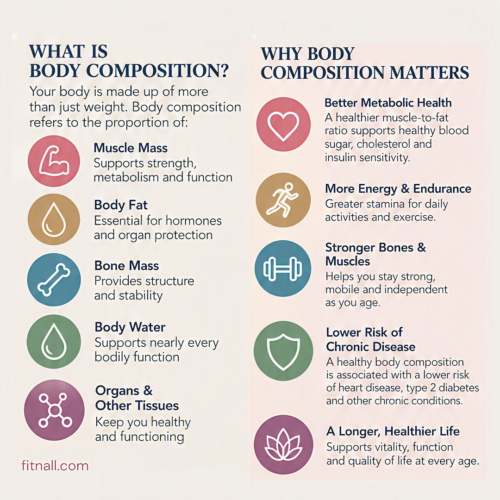
Body composition looks beyond how much you weigh and considers what your body is actually made of. Body composition describes the relative amounts of fat mass and fat-free tissue in the body. It provides a much more meaningful picture of physical health, metabolic function, strength, and healthy aging.
Your total body weight is made up of several different tissues and substances, including:
- Fat mass – essential and stored body fat
- Skeletal muscle – the muscles responsible for movement, strength, posture, and much of glucose disposal
- Bone – the mineral-rich structural framework of the body
- Organs and other tissues
- Body water – water contained both inside and outside cells
Body composition models organize these components somewhat differently depending on the measurement method. For example, a simple two-compartment model separates the body into fat mass and fat-free mass, while more sophisticated assessments distinguish bone mineral, lean soft tissue, fat tissue, and other components.
Keep in mind that muscle and lean mass are not interchangeable terms. Muscle mass refers specifically to muscle tissue, particularly skeletal muscle. Lean mass encompasses everything in the body that is not fat, including muscle, body water, organs, and other tissues, and, depending on the measurement/reporting method, bone mineral may be included or reported separately.
Ultimately, the goal is not simply to weigh less. It is to develop and maintain a body composition that supports metabolic health, physical capability, hormonal function, resilience, and longevity.
Not All Body Fat Is the Same
Fat tissue plays essential roles in energy storage, hormone production and signaling, insulation and temperature regulation, organ protection, absorption and storage of fat-soluble vitamins, and reproductive and physiological function.
Body fat is not inherently unhealthy. Problems arise when excessive fat accumulates, particularly in metabolically unfavorable locations.
Two major categories of stored fat are subcutaneous fat and visceral fat.
- Subcutaneous Fat: Subcutaneous fat sits beneath the skin. It is the fat you can typically pinch around areas such as the abdomen, thighs, hips, and arms.
- Visceral Fat: Visceral fat accumulates deeper within the abdominal cavity around internal organs. Excess visceral adipose tissue is particularly important because greater central and visceral fat accumulation is associated with insulin resistance, type 2 diabetes, cardiovascular disease, and other cardiometabolic problems.
This means where you carry fat can matter in addition to how much fat you carry. Here, waist-to-height or waist-to-hip measurements can therefore provide information that body weight and BMI alone cannot.
Muscle Is Much More Than Something That Makes You Look Fit
Skeletal muscle is often discussed primarily in terms of appearance, but muscle is an extraordinarily important physiological tissue.
Muscle allows you to:
- produce force
- move efficiently
- maintain posture
- stabilize joints
- perform everyday activities
- remain physically independent
A healthy muscle-to-fat ratio also plays an important metabolic role. Skeletal muscle is a major site of glucose uptake and storage. Maintaining adequate muscle mass and regularly contracting that muscle through physical activity can support glucose regulation and metabolic health.
Muscle also provides an important reserve during periods of illness, injury, immobilization, or physiological stress. For these reasons, building and preserving muscle should not be viewed simply as a bodybuilding goal.
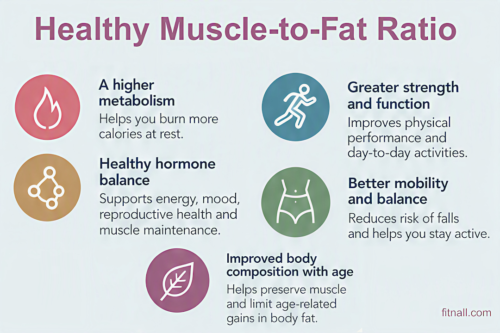
An optimal muscle-to-fat ratio is an important component of metabolic health, physical performance, and bioaging.
Sarcopenia: The Muscle-Loss Problem
One of the most important body-composition changes associated with aging is the progressive loss of skeletal muscle mass and function. Clinically significant loss of muscle and physical function is known as sarcopenia.
The issue is particularly concerning because a person does not necessarily have to look thin to have inadequate muscle. Someone can carry significant body fat while simultaneously having low muscle mass and function, a condition referred to as sarcopenic obesity.
In other words, being heavier does not necessarily mean having more useful lean tissue, and being lighter does not necessarily mean being healthier.
Preserving muscle becomes increasingly important throughout adulthood because it helps support:
- strength
- mobility
- balance
- glucose regulation
- physical independence
- recovery from illness or injury
- the ability to remain active later in life
As you age, the goal is not to keep your weight down but to lose body fat while preserving your muscle, strength, metabolic health, and physical capacity.
Healthy Body Composition Does Not Mean Extreme Leanness
Fitness culture can create the impression that lower body fat is always better, but that isn’t necessarily the case. Healthy body composition should not be confused with trying to become as lean as possible.
Humans require body fat for normal physiological function, and extremely low body-fat levels can interfere with hormonal function, reproductive health, energy availability, recovery, immunity, and physical performance.
The goal is an appropriate balance of fat, muscle, bone, and other tissues that supports your health and life. For one person, improving body composition may mean reducing excess visceral fat. For another, it may mean gaining muscle. For an older adult, preserving muscle and bone may be the priority. For an athlete, performance and recovery may matter more than achieving a lower scale weight.
There is no single appearance that defines metabolic health.
Your Weight Doesn’t Tell the Whole Story
You can’t rely on the scale to tell you about body composition. If you start weight training and lose some fat while simultaneously gaining muscle, you enhance your muscle-to-fat ratio. However, the scale may barely move even though your waist circumference, strength, insulin sensitivity, appearance, and overall health are improving.
At the same time, losing or gaining weight on the scale can be good or bad. Since muscle, fat, bone, and water contribute to body weight, losing five pounds does not automatically mean losing five pounds of body fat. Likewise, gaining weight doesn’t necessarily mean gaining fat.
Now, imagine two women who are both 5’6″ and weigh 145 pounds. One regularly strength-trains and carries substantial muscle with relatively low visceral fat. The other is sedentary, has low muscle mass, and carries a greater proportion of body fat around the abdomen and internal organs. Their scale weight is identical, but their health profiles are not.
This is one reason body recomposition, reducing excess fat while maintaining or increasing muscle, is more meaningful than weight loss alone.
How about BMI?
Body mass index (BMI) is calculated from height and weight and is widely used as a screening tool. It can be useful when examining large populations and can provide one piece of information about an individual’s health. But it does not directly measure body composition. BMI does not distinguish among fat, muscle, and bone mass, nor does it tell us where body fat is stored. This creates obvious limitations.
An athlete, for example, may have a relatively high BMI because she has a higher muscle-to-fat ratio, which contributes substantially to body weight despite having relatively low body fat. At the other end of the spectrum, someone can have a BMI within the “healthy” range while carrying relatively little muscle and a higher percentage of body fat.
This phenomenon becomes particularly important as you age because muscle and bone can decline while body fat increases without creating dramatic changes in overall weight. BMI should therefore be viewed as one screening measurement, not a complete assessment of metabolic or physical health.
The Problem With Losing Weight at Any Cost
When people aggressively restrict calories, they usually want their bodies to burn stored fat. But weight loss can include both fat and lean tissue. This is one reason crash diets and extreme caloric restriction can work against long-term body-composition goals.
A successful fat-loss strategy should aim to reduce excess body fat while preserving as much muscle as possible. That generally means combining an appropriate energy intake with resistance training, sufficient dietary protein, adequate recovery, and sustainable lifestyle habits.
The objective isn’t simply to lose weight. It is to improve body composition while maintaining a strong, functional body.
What Helps Create a Healthy Body Composition?
Body composition reflects the interaction of many biological and behavioral factors. There is no single exercise, food, supplement, or hormone that determines it. Several factors work together.
1. Strength Training
Resistance training provides the mechanical stimulus to increase muscle mass and improve muscle function. Progressively challenging muscles through exercises such as squats, deadlifts, rows, lunges, presses, and other resistance movements helps maintain or increase muscle mass and strength.
Strength training becomes particularly valuable as we age because the goal is not simply to build muscle today; it is to preserve physical capacity for the decades ahead.
2. Adequate Protein
Muscle tissue is constantly being broken down and rebuilt. Dietary protein provides amino acids needed for muscle protein synthesis and tissue repair.
Protein requirements vary depending on body size, age, activity level, health status, energy intake, and training demands. This is where calculating your macronutrients can help. Rather than treating protein as an afterthought, it should be incorporated intentionally into a balanced nutritional strategy.
3. Appropriate Energy Intake
Body composition is influenced by energy balance. Someone trying to reduce excess body fat generally needs an energy intake that supports fat loss, while someone attempting to build substantial muscle may benefit from greater energy availability.
However, extremes can be counterproductive. Severe restriction can compromise training, recovery, nutrient intake, and lean-tissue preservation. Identifying your caloric needs can allow you to plan your meals in a way that supports your health and energy in a sustainable way.
4. Sleep and Recovery
Muscles don’t become stronger or bigger simply because you trained them. Training provides the stimulus, but recovery allows adaptation to take place.
Adequate sleep and recovery days support exercise performance, tissue repair, appetite regulation, and many of the physiological processes involved in maintaining healthy body composition. More exercise is therefore not always better.
The combination of training + nutrition + recovery creates the transformation you are looking for.
5. Stress Management
Chronic psychological stress can affect sleep, appetite, food choices, activity levels, and recovery. This is why body composition cannot always be reduced to the simplistic instruction to “eat less and exercise more.” Human physiology operates as an interconnected system, and stress influences it.
Stress management can help maintain homeostasis, make healthy behaviors easier to maintain, and improve recovery to allow your weight to stabilize.
6. Hormonal and Metabolic Health
Hormones help regulate appetite, energy expenditure, glucose metabolism, reproductive function, stress responses, and muscle and fat metabolism.
Hormonal changes due to age, medical conditions, medications, and other physiological factors can influence body composition.
Lifestyle habits cannot control every hormonal variable, but balancing your hormones along with the lifestyle habits described above helps create an environment that supports healthier metabolic function and body recomposition.
How to Measure Progress: Look Beyond the Scale
Rather than concentrating on the scale, a better progress dashboard might include several markers that show body composition, muscle-to-fat ratio, physical performance, and physiological function:
Body-Composition
No body-composition measurement is perfect. Different methods vary considerably in accuracy, accessibility, cost, and usefulness.
DEXA
Dual-energy X-ray absorptiometry can estimate bone mineral content, lean soft tissue, and fat mass and can provide information about regional body composition.
It is one of the more sophisticated options available outside research settings, although it costs more and is less accessible than simple measurements.
Bioelectrical Impedance
Many smart scales and handheld devices estimate body composition by passing a small electrical current through the body. These devices can be useful for observing long-term trends, but individual readings can fluctuate based on hydration, food intake, exercise, and other factors.
Consistency in measurement conditions is therefore important.
Waist-to-Height Ratio (WHtR)
This is a convenient screening measure of abdominal fat distribution and associated health risk. It is useful because it captures central adiposity, which is more closely related to cardiometabolic risk than body weight alone.
To calculate, divide your waist circumference by your height using the same units [Waist-to-height ratio = waist circumference ÷ height].
The ideal is to maintain your waist circumference below half your height, corresponding to a WHtR below approximately 0.5. For example, someone who is 66 inches tall would use 33 inches as the 0.5 waist-to-height reference point.
Progress Photos and Clothing Fit
Photos and how clothing fits can reveal changes that the scale misses, particularly when someone is losing fat while building or preserving muscle.
Physical Performance
A body that weighs less but is weaker, poorly nourished, exhausted, and losing muscle isn’t moving toward better health. Body composition should not be separated from function.
Therefore, you can measure:
Ask: Are you stronger? Can you lift more? Can you move better? Do everyday activities feel easier? Has your endurance improved?
Physiological Function
Your metabolic health, lifestyle habits, and recovery rate can also illustrate your body’s state.
Metabolic Health
- blood pressure
- blood glucose
- triglycerides
- cholesterol and other relevant laboratory markers
Lifestyle and Recovery
- sleep
- energy
- training consistency
- nutrition quality
- stress management
These measures together create a much more comprehensive picture than asking whether the scale went down.
Build a Body That Supports Your Life
The scale measures gravity’s pull on your body. It does not measure your strength. It doesn’t tell you how much muscle you have, where your body fat is stored, how well you regulate glucose, how strong your bones are, how effectively you move, or how physically capable you will be decades from now. That is why healthy body composition is a more meaningful goal than simply becoming lighter.
Stay active, nourish your body, and recover adequately to increase your muscle-to-fat ratio, preserve bone density, and reduce excessive visceral fat. Measure progress by what your body can do, not simply by what it weighs. The ultimate goal isn’t to occupy less space. It is to have a healthy body composition that maintains a strong, metabolically healthy body that supports the life you want to live.
Healthy body composition illustrates why lasting health requires more than a diet or workout program. The FITNALL App takes a whole-person approach, integrating personalized fitness, nutrition, mindset, stress management, recovery, and longevity habits, to help you move beyond simply losing weight and build a stronger, healthier, more resilient body that functions well for life.
Ready to improve your body composition from the inside out? Start your personalized FITNALL journey today.
Frequently Asked Questions
Healthy body composition refers to having an appropriate balance of body fat, muscle, bone, water, and other lean tissues that supports metabolic health, physical function, and overall well-being. Rather than focusing on a specific weight or appearance, healthy body composition emphasizes adequate muscle and bone mass, appropriate body-fat levels and distribution, and the ability to function well.
Body weight tells you how much your entire body weighs but does not distinguish between fat, muscle, bone, and water. Two people can weigh the same while having very different amounts of muscle and body fat. Looking at body composition provides additional information about metabolic health, strength, physical function, and health risks that scale weight alone cannot provide.
There is no single ideal muscle-to-fat ratio that applies to everyone. Healthy body composition varies according to factors such as age, sex, genetics, activity level, and health status. Instead of pursuing one universal ratio, focus on maintaining adequate muscle and bone mass while avoiding excessive body fat, particularly visceral fat, and supporting strength, mobility, and metabolic health.
Yes. A person can fall within a conventional healthy weight or BMI range while having relatively low muscle mass and a higher proportion of body fat. This is one reason weight and BMI should be considered alongside other indicators such as waist circumference, strength, physical activity, metabolic markers, and, when appropriate, body-composition measurements.
Visceral fat is fat stored deep within the abdominal cavity around internal organs. Excess visceral fat is associated with greater cardiometabolic risk, including insulin resistance, type 2 diabetes, and cardiovascular disease. This is why the location of body fat can be important in addition to the total amount of fat a person carries.
No. BMI is calculated using height and weight and does not directly measure body fat, muscle mass, bone mass, or fat distribution. It can be a useful screening tool, particularly at the population level, but it should not be treated as a complete assessment of an individual’s body composition or health.
Body recomposition refers to improving the relative amounts of fat and lean tissue in the body, typically by reducing excess body fat while maintaining or increasing muscle. Because fat loss and muscle gain can occur at the same time, someone undergoing body recomposition may experience significant physical and metabolic improvements without a dramatic change on the scale.
Improving body composition generally involves combining resistance training, regular physical activity, adequate protein and nutrient intake, appropriate energy intake, quality sleep, stress management, and sufficient recovery. The most effective approach is one that can be sustained over time rather than an extreme diet or exercise program designed to produce rapid weight loss.
Maintaining muscle helps preserve strength, mobility, balance, metabolic function, and the ability to perform everyday activities. Age-related losses in muscle mass and function can contribute to frailty and loss of independence, making resistance training, adequate nutrition, and regular physical activity increasingly important throughout adulthood.
Yes. Weight loss can come from fat, muscle, water, or a combination of these. Losing significant muscle along with body fat may reduce scale weight without producing the desired improvements in strength and physical function. A well-designed fat-loss program should therefore aim to reduce excess fat while preserving as much muscle as possible.
You can monitor waist circumference, how your clothes fit, progress photos, strength, exercise performance, energy levels, and other health markers. DEXA scans and bioelectrical impedance devices can also estimate body composition. Looking at several indicators over time usually provides a more useful picture than relying on a single measurement.
Not necessarily. Body fat performs essential physiological functions, and extremely low levels can negatively affect energy availability, hormonal and reproductive function, recovery, and physical performance. Healthy body composition is not about becoming as lean as possible; it is about maintaining a balance of muscle, fat, bone, and other tissues that supports health, function, and bioaging.
To a Fitter Healthier You,
Mind-Body Optimization Specialist
About the Author
Adriana Albritton is a Mind-Body Optimization Specialist and founder of FitnAll Coaching. She developed the FITNALL Method, a holistic framework that integrates fitness, internal health, thought patterns, nutrition, adaptation, longevity, and lifestyle habits to support sustainable fat loss and long-term wellness. Adriana is the author of 28 Days to a New Life: A Holistic Program to Get Fit, Delay Aging, and Enhance Your Mindset. She speaks and writes about holistic performance, longevity, and the integration of mind and body for optimal health.