Most people focus on building strength, losing weight, or improving cardiovascular fitness. While these are important, two often-overlooked components of health and performance are balance and coordination. Whether you’re an athlete, an active adult, or simply want to maintain your independence as you age, good balance and coordination allow your body to move efficiently, react quickly, and reduce the risk of falls and injuries. The good news is that balance and coordination aren’t fixed abilities; they can be trained at any age. With consistent practice, you can improve stability, enhance athletic performance, sharpen your brain-body connection, and move with greater confidence in everyday life. In this guide, you’ll learn what balance and coordination are, why they matter, what affects them, and practical ways to improve both.
What Is Balance?
Balance is your body’s ability to maintain its center of gravity over its base of support, whether you’re standing still, walking, exercising, or reacting to unexpected movements. Every time you stand on one leg to put on a shoe, walk across uneven ground, or catch yourself after tripping, your body is constantly making tiny adjustments to keep you upright. Although these corrections happen automatically, they rely on an intricate communication network between your brain, nervous system, muscles, joints, and sensory organs.
There are two primary types of balance that you use throughout the day: static balance and dynamic balance.
Static balance is your ability to remain stable while your body stays in one position. Examples include standing on one foot, holding a yoga pose, or maintaining proper posture while waiting in line. Although these activities appear motionless, your muscles are constantly making small corrections to prevent you from swaying or falling.
Dynamic balance, on the other hand, is your ability to remain stable while your body is moving. Every step you take requires dynamic balance, as does climbing stairs, running, changing direction, lifting weights, or participating in sports. Dynamic balance becomes even more important when you encounter unexpected situations, such as stepping on an uneven surface or quickly changing direction to avoid an obstacle.
Maintaining good balance requires several body systems to work together seamlessly.
- The Vestibular System: Located within the inner ear and acts as your body’s internal balance center. It detects the position and movement of your head, helping you determine whether you’re standing upright, leaning, rotating, or accelerating. This information allows your brain to adjust your posture before you even realize you’ve moved.
- Vision: Plays a major role in balance. Your eyes provide continuous information about your surroundings, helping your brain determine your body’s position relative to the environment. This is why maintaining balance becomes much more difficult when you close your eyes or walk in poor lighting.
- Proprioception: Your body’s “sixth sense” – Your ability to sense where your body parts are without looking at them. Specialized receptors in your muscles, tendons, ligaments, and joints constantly send information to your brain about joint position, muscle tension, and movement. This allows you to walk without watching your feet, climb stairs confidently, or catch yourself before losing your balance.
- Muscles and Joints: Your body’s stabilizers. Strong muscles, particularly those in your core, hips, glutes, legs, and ankles, help control movement and keep your joints properly aligned. Flexible joints and adequate mobility also allow your body to adapt quickly when your center of gravity shifts, reducing the likelihood of falls or injuries.
- Brain: Your control center. Every second, it receives information from your eyes, inner ear, muscles, joints, and skin, rapidly processes that data, and sends signals back to your muscles to make countless tiny adjustments. These corrections happen in fractions of a second, allowing you to stay stable even as your environment constantly changes.
Because balance depends on so many interconnected systems, problems in any one area, such as muscle weakness, poor vision, reduced mobility, inner ear disorders, neurological conditions, chronic stress, fatigue, or aging, can affect your ability to stay steady.
What Is Coordination?
Coordination is your body’s ability to perform smooth, accurate, and efficient movements by allowing your brain and muscles to work together as a team. Every movement you make, whether you’re walking, catching a ball, typing on a keyboard, or lifting weights, depends on your nervous system sending precise signals to the right muscles at the right time and with the right amount of force.
Unlike strength, which determines how much force your muscles can produce, coordination determines how well you use that strength. Proper communication between your brain and body allows for good coordination, helping you move with confidence, conserve energy, and react quickly to changes in your environment.
Coordination relies on several important abilities working together:
- Timing: The ability to activate muscles in the correct sequence. Whether you’re swinging a golf club, climbing stairs, or throwing a punch, each muscle must contract and relax at precisely the right moment for the movement to be efficient.
- Precision: How accurately you can control your movements. Precise coordination allows you to place your foot exactly where you intend, pour a drink without spilling, thread a needle, or perform complex athletic skills with consistency.
- Smooth Movement: When your muscles work together seamlessly instead of fighting against one another. Coordinated movements appear fluid, controlled, and effortless because the nervous system is constantly making tiny adjustments as you move.
- Reaction Time: Measures how quickly your brain processes information and directs your body to respond. Whether you’re catching yourself after tripping, avoiding an obstacle while running, or returning a tennis serve, faster reaction times help improve both performance and safety.
- Fine Motor Skills: Involve small, precise movements using the hands and fingers, such as writing, buttoning a shirt, using utensils, or typing on a keyboard.
- Gross Motor Skills: involve larger movements of the arms, legs, and trunk, allowing you to walk, jump, squat, throw, lift, or change direction during physical activity.
Your coordination depends on constant communication between your brain, spinal cord, muscles, joints, eyes, and vestibular system. As you practice new movements, your brain creates stronger neural pathways through a process called motor learning, allowing those movements to become faster, smoother, and more automatic over time.
Balance vs. Coordination
| Balance | Coordination |
|---|---|
| Staying stable | Moving efficiently |
| Preventing falls | Producing smooth movement |
| Controlled posture | Controlled motion |
| Standing on one leg | Catching a ball |
Why Balance and Coordination Matter
1. Reduce Falls
Good balance is one of the most effective ways to reduce your risk of falls, which are a leading cause of injury, especially as you get older. Beginning around age 50, natural changes in muscle mass, reaction time, vision, and the vestibular system can gradually affect your stability. If you don’t actively train these systems, simple activities like stepping off a curb, walking on uneven ground, or reaching for something on a high shelf can become more challenging.
2. Improve Athletic Performance
No matter what sport or recreational activity you enjoy, balance and coordination play a major role in your performance. Every time you change direction, accelerate, jump, land, or react to an opponent, your nervous system must coordinate dozens of muscles simultaneously while keeping your body stable.
Whether you’re playing tennis, pickleball, soccer, basketball, skiing, or simply running, better balance allows you to generate more power, change direction more efficiently, and maintain proper body control under fatigue. Improved coordination also enhances timing, accuracy, and reaction speed, helping you move more fluidly and perform at a higher level while reducing unnecessary energy expenditure.
3. Increase Functional Fitness
Balance and coordination aren’t just important in the gym; they’re essential for every day life. Functional fitness is your ability to move safely and efficiently during normal daily activities, and these skills are at the center of nearly every movement.
When your balance and coordination improve, everyday tasks become easier and require less effort. Walking upstairs, carrying groceries, lifting children, gardening, hiking, getting out of a chair, or reaching into a cabinet all rely on your body’s ability to stabilize itself while moving. Better movement efficiency also means you expend less energy and place less stress on your joints.
4. Enhance Brain Health
Balance and coordination training isn’t just exercise for your body; it’s also exercise for your brain. Every movement requires constant communication between your brain, nervous system, muscles, joints, eyes, and inner ear. The more you challenge these systems, the stronger and more efficient those neural connections become.
This process, known as neuroplasticity, is your brain’s ability to adapt and create new neural pathways through learning and experience. As you practice new movement patterns, your brain improves motor learning, allowing movements to become smoother, faster, and more automatic over time.
Research also suggests that activities requiring coordination and balance can support cognitive function by stimulating areas of the brain involved in attention, planning, memory, and spatial awareness. In other words, training your balance doesn’t just help you move better—it helps keep your brain actively engaged throughout life.
5. Improve Posture
Good posture begins with body awareness. Your brain must constantly receive information from your body to determine where it is in space. When this communication is efficient, you’re better able to maintain proper alignment whether you’re standing, walking, exercising, or sitting at your desk.
As your balance and coordination improve, you naturally become more aware of your posture and movement patterns. Stronger stabilizing muscles, particularly in your core and hips, help keep your spine aligned and reduce unnecessary strain on your neck, shoulders, and lower back. Better posture not only improves your appearance but also enhances breathing efficiency, movement quality, and long-term joint health.
6. Prevent Injuries
One of the greatest benefits of improving your balance and coordination is reducing your risk of injury. Many injuries occur not because a muscle isn’t strong enough, but because your body cannot react quickly enough to unexpected movements or changes in position.
Better coordination allows your muscles to activate at precisely the right time, while improved balance helps your joints remain properly aligned during movement. This enhanced neuromuscular control reduces excessive stress on your ligaments, tendons, and joints. As a result, you’re less likely to experience common injuries such as ankle sprains, knee injuries, falls, and lower back pain.
Factors That Affect Balance and Coordination
Your ability to maintain balance and move with coordination depends on multiple body systems working together seamlessly. When any part of the system is impaired, your balance and coordination can suffer.
Age
As you age, it’s normal to experience gradual changes that affect balance and coordination. Muscle mass and strength naturally decline, reaction times slow, vision may become less sharp, the vestibular system in your inner ear becomes less sensitive, and proprioception decreases over time. These changes can increase the risk of falls but are not inevitable. Regular strength training, balance exercises, and staying physically active can significantly slow or even reverse many age-related declines.
Sedentary Lifestyle
If you spend most of your day sitting, your muscles weaken, your joints become less mobile, and your nervous system receives fewer opportunities to practice maintaining stability. Inactivity gradually reduces your body’s ability to react to unexpected movements or changes in terrain. Simply incorporating more movement into your daily routine can help.
Poor Posture
Your posture directly affects how efficiently your body maintains its center of gravity. Rounded shoulders, a forward head position, excessive arching of the lower back, or other postural imbalances alter your body’s alignment and force your muscles to work harder to keep you stable. Improving posture through strengthening, mobility exercises, and body awareness makes everyday movements feel more natural and controlled.
Muscle Weakness
Strong muscles provide the foundation for stability. Weakness in the legs, hips, core, and ankles makes it more difficult to control movement and recover when you lose your balance. Your core muscles, in particular, act as the body’s central stabilizers, helping transfer force between the upper and lower body while maintaining proper posture during movement.
Vision Problems
Your eyes provide essential information about your surroundings and help your brain determine where your body is in space. Blurred vision, reduced depth perception, cataracts, or other vision impairments make it harder to detect obstacles, judge distances, and maintain stability.
Inner Ear Disorders
Your vestibular system, located within the inner ear, continuously monitors head movement and spatial orientation. Conditions such as benign paroxysmal positional vertigo (BPPV), Ménière’s disease, vestibular neuritis, or other inner ear disorders can interfere with this system, leading to dizziness, vertigo, unsteadiness, and poor balance.
Neurological Conditions
The brain and nervous system coordinate every movement you make. Neurological disorders such as Parkinson’s disease, multiple sclerosis, stroke, peripheral neuropathy, and certain brain injuries can disrupt communication between the brain and muscles, making movements slower, less precise, or more difficult to control.
Certain Medications
Some prescription and over-the-counter medications can affect balance by causing dizziness, drowsiness, blurred vision, or slowed reaction times. Blood pressure medications, sedatives, sleep aids, anti-anxiety medications, antidepressants, and some pain medications are common examples.
Chronic Stress
Chronic stress affects more than your mental well-being; it can also impair your physical performance. Elevated stress hormones increase muscle tension, reduce focus, and interfere with your brain’s ability to process sensory information efficiently. When you’re stressed, your body is also more likely to rely on automatic movement patterns, increasing the risk of poor coordination and injury.
Fatigue
Whether it’s from a demanding workout, a busy work schedule, or insufficient recovery, fatigue reduces both physical and mental performance. Tired muscles respond more slowly, while mental fatigue decreases concentration and reaction time. As a result, even simple movements may require more effort and become less coordinated.
Poor Sleep
Sleep is essential for muscle recovery, motor learning, and nervous system function. During sleep, your brain consolidates movement patterns and strengthens the neural pathways involved in coordination. Chronic sleep deprivation has been shown to impair reaction time, decision-making, balance, and overall physical performance.
Alcohol
Alcohol affects multiple systems involved in balance, including the brain, inner ear, and nervous system. Even moderate amounts can impair reaction time, coordination, depth perception, and judgment. This is one reason why falls and accidents become significantly more common after alcohol consumption.
Nutritional Deficiencies
Proper nutrition supports healthy muscles, nerves, bones, and brain function—all of which contribute to balance and coordination. Nutritional deficiencies such as vitamin B12, vitamin D, magnesium, calcium, and omega-3 fatty acids can negatively affect nerve signaling, muscle function, and overall stability. Inadequate hydration can also contribute to dizziness, muscle cramps, and reduced physical performance.
The Role of Core Strength
When people think about the core, they often picture a six-pack. In reality, your core is much more than your abdominal muscles. It functions as your body’s central stabilizing system, providing the foundation for nearly every movement you make. Your core helps keep your body stable, aligned, and balanced.
A strong core allows your arms and legs to generate force efficiently while keeping your spine and pelvis stable. Without adequate core strength, your body compensates with inefficient movement patterns that can reduce coordination, increase fatigue, and raise your risk of falls and injuries.
Your core is made up of several muscle groups that work together as a team. These include your abdominal muscles, obliques, diaphragm, pelvic floor, glutes, and spinal stabilizers. When these muscles work together, they create a stable platform that allows your body to move with greater control and precision.
Best Exercises to Improve Balance & Coordination
Balance Exercises
Fortunately, balance is a highly trainable skill. By improving strength, mobility, proprioception, and neuromuscular control, you can teach your brain and body to work together more efficiently, improving stability, and overall movement.
- Single-leg stand
- Heel-to-toe walk
- Side plank oblique raises
- Single-leg deadlift to jump
- Step-ups
- Single-leg squat to chair
- Single-leg balance and reach
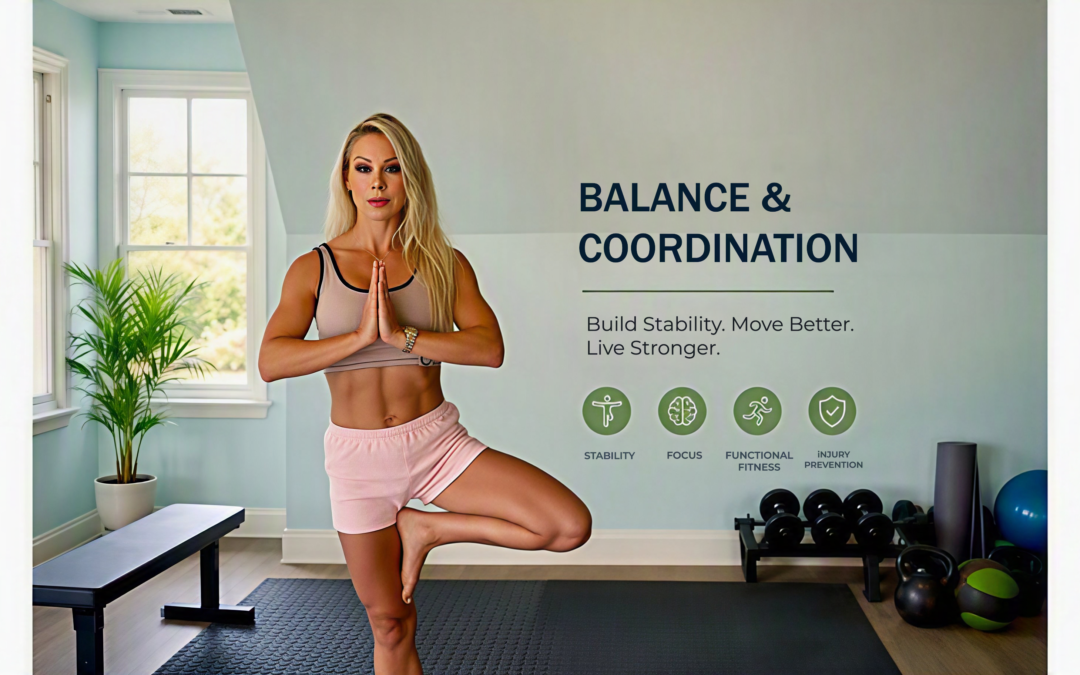
- Tree pose
- Reverse lunge with knee hop
- Warrior III
- Side lunges
- High plank
- Single-arm chest press
- Stability ball knee tuck
- BOSU exercises
- Balance board exercises
- Stability ball work
Coordination Exercises
Coordination is also highly trainable. Challenging your body with new movement patterns, balance exercises, agility drills, resistance training, sports, dancing, or activities that require precision encourages your nervous system to adapt. As these neural connections become more efficient, your movements become smoother and your reaction time improves.
- Agility ladder
- Cone drills
- Jump rope
- Ball toss
- Dance
- Tai Chi
- Shadow boxing
- Reaction drills
- Medicine ball throws
Activities That Naturally Improve Both
While dedicated balance and coordination exercises are highly effective, you can also develop these skills by participating in activities that naturally challenge your body and nervous system. These activities require you to continually adjust your posture, react to changing environments, and coordinate movements, making them enjoyable ways to build stability and body awareness.
Walking on uneven trails, hiking, rock climbing, martial arts, yoga, pilates, pickleball, tennis, skating, swimming, and paddleboarding are great examples. But ultimately, the best activity is the one that you enjoy and can practice consistently.
How Often Should You Train?
General recommendation:
- 2–4 sessions per week
- 10–20 minutes
- Progress gradually
- Include different movement patterns
Common Mistakes
Many people assume that balance and coordination will naturally improve as they become stronger or more active. While strength is an important part of the equation, these skills require specific training. Avoiding the following common mistakes can help you make faster progress and reduce your risk of injury.
- Only Lifting Weights: Lifting weights alone won’t fully develop your balance and coordination. To develop well-rounded movement skills, incorporate exercises that require stability, body awareness, and controlled movement in multiple directions.
- Never Training on One Leg: If all of your exercises are performed with both feet planted on the ground, you’re missing an important opportunity to strengthen stabilizing muscles and improve balance. Adding single-leg exercises can significantly improve stability and coordination.
- Ignoring Mobility: Limited mobility in your ankles, hips, or thoracic spine can make maintaining proper balance much more difficult. Regular mobility work helps improve range of motion, posture, movement efficiency, and your ability to maintain balance during everyday activities and exercise.
- Always Exercising on Machines: Resistance machines are excellent for targeting specific muscles, but they provide external stability that reduces the work your stabilizing muscles must perform. Free weights, resistance bands, bodyweight exercises, and functional movements require greater control and activate the muscles responsible for maintaining balance.
- Wearing Poor Footwear: Your feet are your foundation, and the shoes you wear can have a significant impact on your balance. Worn-out shoes, overly cushioned footwear, or shoes that don’t fit properly can reduce stability and alter your body’s natural movement patterns. Choose supportive footwear that’s appropriate for your activity, and perform balance exercises barefoot to strengthen the muscles of your feet and improve proprioception.
- Doing the Same Routine Repeatedly: Your nervous system adapts quickly to familiar movements. If you perform the same exercises in the same way every week, your balance and coordination improvements may plateau. Challenge your brain and body by varying your workouts. Try new movement patterns, different surfaces, changes in speed, or exercises that require quick reactions. Variety helps stimulate continued adaptation and keeps your nervous system engaged.
By avoiding these common mistakes and intentionally incorporating balance and coordination training into your routine, you’ll build a stronger foundation for better athletic performance, safer movement, and healthier aging. Small changes made consistently can lead to significant improvements in the way you move and feel every day.
Balance and Coordination Across the Lifespan
Balance and coordination are essential at every stage of life. Children and adolescents need them for motor skill development and athletic performance, adults for performance and injury prevention, and older adults for independence, fall prevention, and healthy aging.
Although these abilities naturally change over time, regular training can strengthen the connection between your brain and body, helping you move better, reduce your risk of injury and falls, and maintain an active, healthy lifestyle.
Nutrition That Supports Balance and Coordination
What you eat plays an important role in how well your brain, muscles, and nervous system work together.
To support balance and coordination, focus on:
- Eating enough protein to maintain muscle strength
- Omega-3 fatty acids for brain health
- Vitamin D and magnesium for muscle and nerve function
- Vitamin B12 for healthy nerve signaling
- Electrolytes and adequate hydration to support muscle contractions and balance
- A diet rich in colorful fruits and vegetables also provides antioxidants that help protect the brain and nervous system from oxidative stress
Conclusion
Balance and coordination are more than just athletic skills; they are essential for moving confidently, preventing injuries, and maintaining independence throughout life. Every step you take, every object you lift, and every movement you make relies on your brain, muscles, joints, and senses working together efficiently.
The encouraging news is that these abilities can be improved at any age. By incorporating balance and coordination exercises, functional strength training, mobility work, and activities that challenge your nervous system, you can enhance stability, react more quickly, and move with greater confidence in both everyday life and sports.
Rather than treating balance as a separate workout, the FITNALL Method develops it through a comprehensive mind-body approach. Strength training, functional movement, mobility, proper nutrition, stress management, quality sleep, and mindset all influence how effectively your brain and body communicate and contribute to better stability, coordination, and body awareness, creating a stronger foundation for lifelong mobility and healthy aging.
Whether your goal is to excel in your favorite sport, reduce your risk of falls, or simply feel more stable and capable in everyday activities, investing in your balance and coordination today will pay dividends for years to come.
Ready to move with greater confidence? The FITNALL App provides guided workouts, functional training programs, mobility exercises, and holistic coaching designed to improve strength, stability, coordination, and overall health—helping you build a body that performs better today and remains resilient for years to come.
Key Takeaways
- Balance and coordination are trainable skills at any age.
- They depend on your muscles, nervous system, vision, vestibular system, and brain working together.
- Improving them can enhance athletic performance, reduce injuries, and support healthy aging.
- Functional exercises, mobility work, core strengthening, and varied movement patterns are among the best ways to build these abilities.
- Nutrition, sleep, stress management, and overall health also play an important role in how well you move.
Frequently Asked Questions
Balance is your ability to maintain stability, while coordination is your ability to control smooth, efficient movement. They work together to help you move safely and effectively.
Yes. Research shows that balance and coordination can improve throughout life with regular practice, strength training, mobility exercises, and activities that challenge your nervous system.
Aim for 10–20 minutes, two to four times per week. Consistency is more important than long sessions.
Single-leg exercises, Tai Chi, yoga, and functional strength training are among the most effective ways to improve balance.
Yes. Functional strength training enhances communication between your brain and muscles, helping improve movement efficiency, stability, and overall coordination.
To a Fitter Healthier You,
Mind-Body Optimization Specialist
About the Author
Adriana Albritton is a Mind-Body Optimization Specialist and founder of FitnAll Coaching. She developed the FITNALL Method, a holistic framework that integrates fitness, internal health, thought patterns, nutrition, adaptation, longevity, and lifestyle habits to support sustainable fat loss and long-term wellness. Adriana is the author of 28 Days to a New Life: A Holistic Program to Get Fit, Delay Aging, and Enhance Your Mindset. She speaks and writes about holistic performance, longevity, and the integration of mind and body for optimal health.