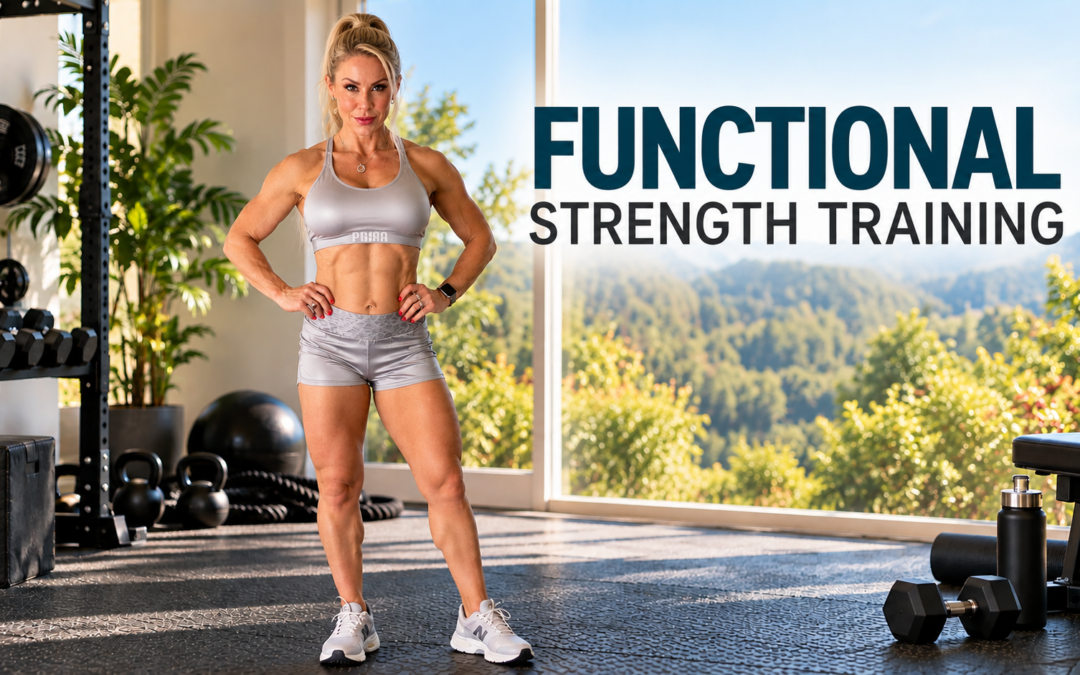
Being strong in the gym is valuable. But the ultimate purpose of strength goes far beyond how much weight you can lift. Functional strength isn’t just about building bigger muscles or having better body composition. It involves teaching your muscles, joints, nervous system, balance, and movement patterns to work together efficiently. This article delves into what functional strength training is, its benefits for movement, longevity, and the real world, and the best functional training exercises to help you live a better life.
Functional Strength
Can you get off the floor easily? Carry heavy grocery bags without straining your back? Climb several flights of stairs without feeling depleted? Catch yourself if you lose your balance? Lift a suitcase into an overhead compartment easily? Move furniture, play with your children or grandchildren, garden, hike, travel, and continue doing the things you enjoy as you get older?
These abilities depend on functional strength—the capacity to produce, control, and coordinate force effectively during real-world movements and physical tasks.
Think about picking something up from the floor. Your hips hinge, your knees bend, your core stabilizes your spine, your hands grip the object, and your legs and hips generate force as you stand.
Your body doesn’t think: Now I am performing a hamstring exercise, followed by a glute exercise, followed by a core exercise. It just coordinates multiple muscles and joints simultaneously to accomplish a task. Functional strength training develops that ability.
Functional Strength: More Than Muscle Strength
Having strong muscles matters enormously, but real-world physical capacity requires several systems to cooperate.
Stability
Stability allows you to control joints and maintain appropriate positioning while force is being produced.
Your core, for instance, doesn’t exist simply to create visible abdominal muscles. The muscles surrounding your trunk help stabilize the spine and transfer force between your upper and lower body.
Mobility
Mobility refers to your ability to move through variable ranges of motion with control.
You can have powerful muscles yet still struggle with everyday movements if your ankles, hips, shoulders, or thoracic spine cannot move through wide ranges of motion.
Balance and Coordination
Balance allows you to maintain your center of mass over your base of support, while coordination allows your nervous system to move muscles in correct sequences and at appropriate intensities.
Their importance becomes especially apparent as we age. The WHO specifically recommends that older adults incorporate physical activities emphasizing balance and coordination, along with muscle strengthening, to help reduce fall risk and preserve function.
This is one reason practicing movement patterns matters. Strength is not solely a property of muscle tissue; your nervous system, connective tissue, and joint stability play an essential role in your ability to express that strength.
Power
Strength describes your ability to generate force. Power involves producing force quickly. That matters when you have to climb stairs quickly, catch yourself after stumbling, jump, run, or react suddenly.
Research has identified muscle power as an important component of functional performance in older adults, which is one reason appropriately programmed resistance training can include movements performed with the intention of moving forcefully or quickly.
Functional Strength Training
The objective of functional strength training is to develop strength that you can actually use. It generally emphasizes fundamental movement patterns such as squatting, hip hinging, pushing, pulling, lunging, carrying, rotating, resisting rotation, and other forms of locomotion. But it also involves qualities such as balance, coordination, mobility, stability, power, grip strength, and muscular endurance.
Functional strength training is sometimes presented as the opposite of conventional strength training, but that’s misleading.
Functional training exercises such as squats, deadlifts, rows, presses, pull-ups, lunges, and many other traditional exercises are extremely useful because they strengthen fundamental movement patterns. Even resistance machines, which stabilize the body and isolate movement more than free weights, can improve strength and physical function.
The question isn’t whether an exercise uses a machine, dumbbell, barbell, resistance band, kettlebell, cable, or your own body weight. The real question is: what physical qualities are you developing, and how will they help your body perform?
A leg press can develop lower-body strength that contributes to standing and climbing stairs. A row strengthens the muscles involved in pulling and helps support the upper back. A deadlift develops the hip hinge used when lifting objects from the ground.
Functional strength training therefore doesn’t require standing on a BOSU ball while performing a complicated combination exercise. In fact, making an exercise unnecessarily unstable can sometimes reduce the amount of force you can produce.
Functional training is defined by whether your training improves your ability to meet the physical demands that matter in your life, not by how unusual an exercise looks.
Functional Fitness Doesn’t Mean Training Only for Daily Chores
There’s another misconception worth addressing. If you want to become better at carrying groceries, you don’t have to design your entire workout around carrying grocery bags. Fitness capacity is transferable.
Strengthening your legs through squats can make many lower-body tasks easier. Improving pulling strength can benefit numerous activities. Increasing cardiovascular fitness can make walking, traveling, hiking, and recreational activities less demanding.
This concept gives us freedom. You can lift weights, use machines, train with dumbbells and barbells, use resistance bands, perform bodyweight exercises, sprint, hike, swim, cycle, or play sports. Functional fitness isn’t one training style but an outcome: a body better prepared to meet the demands placed upon it.
The Fundamental Movement Patterns
Human movement is extraordinarily complex, but functional strength training can be organized around several foundational patterns.
1. Squat
Squatting involves bending primarily through the hips, knees, and ankles while maintaining control of the trunk. You use this pattern when you sit down, stand from a chair, use the bathroom, crouch down, or pick something up.
- Training examples: squats, goblet squats, box squats, sit-to-stands.
2. Hip Hinge
A hinge involves moving primarily through the hips while maintaining a relatively stable spine. You hinge when picking up a laundry basket, lifting something from the floor, pushing your hips backward to reach downward, or moving heavy objects.
- Training examples: deadlifts, Romanian deadlifts, kettlebell deadlifts, hip hinges, good mornings.
3. Push
Pushing moves resistance away from the body. You push when opening a heavy door, moving furniture, getting yourself off the floor, or placing something overhead.
- Training examples: push-ups, bench presses, overhead presses, landmine presses.
4. Pull
Pulling brings resistance toward you. Everyday pulling happens when opening doors, pulling objects toward yourself, carrying certain loads, climbing, or performing household tasks.
- Training examples: rows, pull-ups, pulldowns, cable rows.
5. Lunge and Single-Leg Movement
Life rarely occurs with both feet perfectly symmetrical beneath you. Walking, running, climbing stairs, stepping over obstacles, and changing direction require one leg to accept and produce force independently.
- Training examples: reverse lunges, walking lunges, split squats, step-ups, single-leg exercises.
6. Carry
We constantly carry things such as groceries, luggage, children, packages, equipment, and backpacks. Loaded carries integrate grip strength, shoulder stability, core control, posture, lower-body strength, and cardiovascular demand.
- Training examples: farmer’s walks, suitcase carries, front-loaded carries.
7. Rotation and Anti-Rotation
The torso must sometimes rotate and, at other times, prevent unwanted rotation. You use rotational strength when reaching across your body, turning, throwing, swinging, and changing direction. Anti-rotational strength helps your torso remain stable when outside forces try to move it.
- Training examples: cable rotations, Pallof presses, chops, lifts, unilateral carries.
Benefits of Functional Strength Training
Healthy Aging
When you’re young, it’s easy to take physical capacity for granted. Getting off the floor requires little thought. Carrying luggage isn’t a major event. Losing your balance usually results in a quick correction rather than a fall. But physical capacity can gradually decline when you don’t challenge your body.
The goal shouldn’t simply be to increase lifespan. It should also be to preserve as much healthspan and physical independence as possible.
- Can you continue traveling?
- Can you climb stairs?
- Can you carry your own groceries?
- Can you play with your grandchildren?
- Can you get yourself off the floor easily?
- Can you continue living independently?
- Can you get your balance if you stumble?
Research supports resistance training as one strategy for preserving physical function. A meta-analysis involving adults aged 60 and older found improvements in muscle strength, among other outcomes, following resistance training. A systematic review of functional training in community-dwelling older adults also found positive effects on activities of daily living.
Strength: A Longevity Asset
Strength training isn’t only about physical performance. Muscle-strengthening activity is an established component of public-health recommendations.
Observational evidence links resistance training with longevity. A systematic review and meta-analysis found that participation in resistance training was associated with lower all-cause mortality compared with no resistance training.
Maintaining physical capacity should be treated as part of healthy aging. Functional strength training not only adds muscle and strength but also translates into a functional asset.
Functional Strength in Everyday Life
Another benefit of functional strength training is the increased ability to produce and control force effectively during your daily life. Training builds additional physical qualities- stability, mobility, balance, power, and coordination- that can transfer to many activities.
One of the easiest ways to understand functional training is to connect functional training exercises with their real-world counterparts.
| Training Pattern | Gym Example | Everyday Application |
|---|---|---|
| Squat | Goblet squats | Getting out of a chair |
| Hinge | Deadlifts / Good mornings | Picking something off the floor |
| Push | Push-ups / Arnold presses | Pushing a heavy door |
| Pull | Rows | Pulling something toward you |
| Lunge | Side lunge | Stepping, kneeling, climbing |
| Step | Step-ups | Climbing stairs |
| Carry | Farmer’s walks | Carrying groceries |
| Anti-rotation | Pallof press | Stabilizing while carrying an uneven load |
| Rotation | Cable rotation | Turning and reaching |
| Single-leg stability | Single-leg Romanian deadlift | Walking and recovering your balance |
How to Build Functional Strength
A functional strength program doesn’t have to be complicated. In fact, mastering fundamental exercises is usually more productive than constantly searching for creative new movements. A good training program chooses the basic functional training exercises and adds more based on the desired adaptation, not because they look difficult or unconventional.
Start With the Basics
Build your program around major movement patterns:
- Squat + hinge + push + pull + lunge/single-leg work + carry + core stability.
You don’t necessarily need to perform every pattern during every workout. They can be distributed throughout the week.
Train Multiple Planes of Movement
Many workouts occur almost entirely forward and backward—the sagittal plane. But life happens in three dimensions.
- Your program can also include appropriate lateral and rotational movements, such as lateral lunges, carries, chops, rotations, and anti-rotational exercises.
Use Progressive Overload
Your body adapts to the demands you place on it. Over time, you may need to increase resistance, repetitions, range of motion, training volume, exercise complexity, or other variables.
Without progressive challenge, adaptation eventually slows. But progression doesn’t mean making every exercise increasingly complicated. Sometimes the most effective progression is simply performing a basic movement better and stronger.
Include Unilateral Training
Training one side at a time can expose asymmetries and challenge balance and trunk stability.
- Functional training exercises that address your body unilaterally include split squats, step-ups, single-arm rows, single-arm presses, suitcase carries, and other unilateral movements can complement bilateral strength exercises.
Train Your Core to Resist Movement
Core training shouldn’t consist exclusively of crunches. Your trunk also needs to resist excessive extension, lateral flexion, and rotation while transferring force.
- Planks, dead bugs, ab wheel rollouts, Pallof presses, side planks, and compound lifts can help develop these abilities.
Don’t Forget Grip
Grip strength influences your ability to carry, pull, lift, hang, and manipulate objects.
- Loaded carries, deadlifts, rows, pull-ups, and hangs are functional training exercises that can challenge the hands and forearms while simultaneously training other areas of the body.
Challenge Balance Appropriately
Balance training has value, especially as we age, but balance challenges should match the goal. You don’t need to perform every exercise on an unstable surface.
- Single-leg movements, step-ups, lunges, carries, changes in stance, and balance drills can challenge stability without unnecessarily compromising strength development.
The popularity of functional fitness has created an unfortunate misconception that exercises have to be complicated, but that’s not true. Functional training exercises are the key. Exercise selection should have a reason behind it, such as strength, power, balance, mobility, coordination, muscular endurance, or cardiovascular conditioning.
Train for the Life You Want to Keep Living
It’s easy to measure fitness by numbers – how much you weigh, how much you can lift, how fast you can run, or how many calories you burn. Those metrics can be useful, but they don’t tell the whole story. An equally important question is: What is your body capable of doing? Can you move confidently, lift and carry what you need, climb stairs, bend, reach, react, and participate in the activities you love? And are you building a body that will allow you to keep doing those things ten, twenty, or thirty years from now?
Functional strength is an important component of the Fitness pillar of the FITNALL Method. The goal of fitness shouldn’t simply be to look fit. It should be to build a body that is strong, mobile, stable, resilient, adaptable, and capable of supporting the life you want to live. Functional strength training helps you maintain independence and continue engaging fully in life as you age. You’re not simply building muscle or improving your performance in the gym; you’re investing in your future capabilities. You’re building physical freedom: the ability to keep moving, exploring, participating, and living life on your own terms for as long as possible.
Frequently Asked Questions
Functional strength training develops strength that translates into everyday movements and physical activities. It typically incorporates fundamental movement patterns such as squatting, hinging, pushing, pulling, lunging, carrying, and rotating, while also developing stability, mobility, balance, coordination, and core control.
Traditional strength training often focuses on increasing muscular strength, size, or performance in specific exercises, while functional strength training places greater emphasis on how strength contributes to movement and real-world physical capacity. However, the two approaches overlap significantly. Traditional exercises such as squats, deadlifts, rows, presses, and lunges can be highly functional when appropriately programmed.
Functional strength training can improve muscular strength, balance, stability, mobility, coordination, power, and the ability to perform everyday activities. It can also support sports performance, help maintain physical independence, and contribute to healthy aging and longevity when incorporated into a comprehensive fitness program.
The primary functional movement patterns include squatting, hinging, pushing, pulling, lunging or single-leg movement, carrying, and rotating or resisting rotation. Walking, running, climbing, and other forms of locomotion also depend on combinations of these fundamental patterns.
Examples include squats, deadlifts, lunges, step-ups, push-ups, rows, overhead presses, farmer carries, suitcase carries, Pallof presses, and appropriately programmed single-leg exercises. An exercise does not need to be complicated or performed on an unstable surface to be functional.
Yes. Strength, balance, power, mobility, and coordination become increasingly important for maintaining physical function and independence with age. Functional strength training can help older adults maintain the capacity needed for activities such as getting out of a chair, climbing stairs, carrying objects, walking confidently, and recovering from changes in balance.
Most adults can benefit from muscle-strengthening exercise at least two days per week, consistent with major physical-activity guidelines. The ideal frequency depends on your fitness level, goals, training intensity, recovery, health status, and the other activities in your program.
Not necessarily. Functional training and conventional resistance training are not mutually exclusive, and research does not show that exercises labeled “functional” are always superior. A well-designed strength program using free weights, machines, resistance bands, body weight, or a combination of methods can improve strength and physical function. What matters most is selecting exercises and training variables that support your individual goals and abilities.
Functional strength training can support healthy aging and healthspan by helping preserve muscle, strength, balance, mobility, and physical capacity. Resistance training has also been associated with lower all-cause mortality in observational research. Rather than thinking of strength solely in terms of gym performance, maintaining strength throughout life can help preserve the ability to remain active and independent as you age.
To a Fitter Healthier You,
Mind-Body Optimization Specialist
About the Author
Adriana Albritton is a Mind-Body Optimization Specialist and founder of FitnAll Coaching. She developed the FITNALL Method, a holistic framework that integrates fitness, internal health, thought patterns, nutrition, adaptation, longevity, and lifestyle habits to support sustainable fat loss and long-term wellness. Adriana is the author of 28 Days to a New Life: A Holistic Program to Get Fit, Delay Aging, and Enhance Your Mindset. She speaks and writes about holistic performance, longevity, and the integration of mind and body for optimal health.