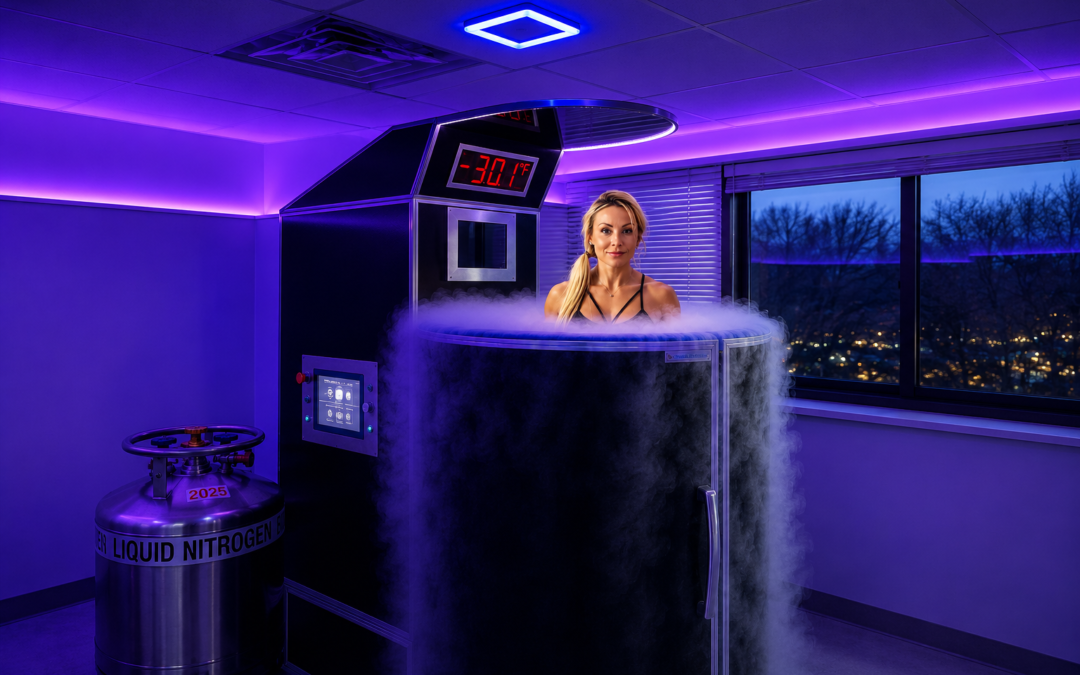
Cryotherapy has become a popular recovery tool among athletes, fitness enthusiasts, and people looking for ways to manage muscle soreness and support overall wellness. But does exposing your body to extremely cold temperatures actually work? Understanding what cryotherapy does and what the research actually shows can help you decide whether it deserves a place in your recovery routine. Discover what cryotherapy is, the benefits of cryotherapy for recovery, pain, and performance, and when to use it.
What Is Cryotherapy?
Cryotherapy means using cold temperatures therapeutically. It can involve applying cold to a specific area of the body or exposing much of the body to extremely cold temperatures for a short period.
Common forms of cold therapy include:
- Whole-body cryotherapy (WBC): Brief exposure to extremely cold air inside a specialized chamber.
- Partial-body cryotherapy: The body is exposed to cold while the head remains outside the chamber.
- Localized cryotherapy: Cold is applied to a specific muscle, joint, or body area.
- Cold-water immersion: Often called a cold plunge or ice bath, where part or most of the body is submerged in cold water.
Whole-body cryotherapy sessions generally last only a few minutes because of the extremely low temperatures involved.
The physiological response to cold, including changes in blood flow, nerve activity, metabolism, and inflammatory signaling, is what researchers are investigating for potential recovery benefits.
What Are the Benefits of Cryotherapy?
Research suggests that cryotherapy and other forms of cold therapy may help reduce post-workout muscle soreness, influence inflammatory responses, and support anti-aging processes and certain aspects of exercise recovery and performance. However, not every benefit attributed to cryotherapy has strong scientific support.
Let’s look into what the evidence says about the benefits of cryotherapy for recovery, pain, performance, and more.
1. May Reduce Muscle Soreness
One of the best-studied uses of cryotherapy is post-exercise recovery and delayed-onset muscle soreness (DOMS). DOMS is the tenderness, stiffness, and discomfort that can appear after strenuous or unfamiliar exercise, often becoming most noticeable during the days following a workout.
Research suggests that cold-based recovery strategies can help decrease muscle soreness after demanding exercise.
A 2026 systematic review involving 51 randomized controlled trials and 1,243 participants found that the effects varied according to the type of cold therapy and timing. Cold-water immersion showed significant reductions in DOMS at 1 and 24 hours, while localized cold therapy produced the greatest reduction at 48 hours.
This makes cold therapy potentially useful after particularly demanding workouts, competitions, or periods of increased training.
2. May Support Exercise Recovery
Another use is cryotherapy for recovery, since it involves more than simply reducing soreness. Strenuous exercise can temporarily affect muscle function, perceived fatigue, inflammation, muscle-damage biomarkers, and subsequent athletic performance
Research suggests that cryotherapy may influence several of these recovery markers. The same 2026 analysis found that whole-body cryotherapy produced significant improvements in countermovement jump performance at several post-exercise time points and affected markers of muscle damage. However, recovery responses depend on factors such as the exercise performed, temperature, duration of exposure, timing, and type of cryotherapy.
Recovery strategies can include active recovery as well as recovery tools and modalities such as cryotherapy, cold-water immersion, massage, compression, and heat therapy. Therefore, cryotherapy is not a replacement for sleep, adequate nutrition, hydration, rest days, and appropriate training programming.
3. May Influence Exercise-Induced Inflammation
Inflammation reduction is another benefit of cryotherapy. Inflammation is part of the body’s normal repair process after exercise. However, excessive or prolonged inflammation can contribute to soreness and delayed recovery.
Cold exposure causes physiological responses that may temporarily influence inflammatory processes and blood flow. Research examining cryotherapy after exercise has reported changes in inflammatory and muscle-damage biomarkers.
For example, recent evidence suggests that whole-body cryotherapy may reduce creatine kinase levels during the days following strenuous exercise, while cold-water immersion may influence inflammatory markers such as interleukin-6.
This doesn’t mean inflammation should always be suppressed. Some inflammation is necessary for normal adaptation to exercise. For that reason, frequent cold exposure immediately after every strength-training session may not necessarily be appropriate for everyone, particularly when the primary goal is to maximize muscular adaptation.
4. May Help With Temporary Pain Relief
Cold has long been used to decrease pain following injuries and strenuous physical activity. Cooling tissues can temporarily decrease nerve conduction and pain sensation, which is one reason localized cold therapy is commonly used for sore muscles and joints.
Whole-body cryotherapy may similarly help some people perceive less soreness or discomfort following strenuous exercise. However, persistent or unexplained pain shouldn’t simply be masked with cold therapy. Pain can be an important signal that an injury or underlying problem needs attention.
5. May Help Athletes Maintain Performance During Heavy Training
Maintaining performance is another benefit of cryotherapy. The ability to recover quickly becomes particularly important when workouts, practices, or competitions occur close together. Research suggests that whole-body cryotherapy may help restore certain measures of physical performance after strenuous exercise.
A 2026 systematic review comparing cold-water immersion with body cryotherapy found that cold-water immersion was more effective for short-term DOMS relief, while body cryotherapy showed a small potential advantage for jump-performance recovery at 24 hours.
When using cryotherapy for recovery, remember that the ideal approach depends on whether your priority is reducing soreness, restoring performance, managing fatigue, or simply feeling ready for your next training session.
Does Cryotherapy Burn Fat or Boost Metabolism?
You’ve probably seen claims that cryotherapy burns hundreds of calories or dramatically increases metabolism. Let’s look into these claims.
Cold exposure does cause thermoregulatory responses because the body must work to maintain its internal temperature. However, there isn’t strong evidence that a few minutes of whole-body cryotherapy produces meaningful or lasting fat loss.
Cryotherapy shouldn’t be considered a weight-loss treatment. For sustainable fat loss and healthy body composition, nutrition, resistance training, cardiovascular activity, sleep, stress management, and caloric intake are far more important.
Is Cryotherapy Anti-Aging?
Chronic inflammation, oxidative stress, metabolic dysfunction, and declining cellular resilience are associated with aging, and it seems like cold exposure is involved in biological pathways associated with healthy aging and longevity.
Research shows that cold exposure may influence cellular stress resistance, mitochondrial function, metabolism, inflammatory pathways, antioxidant defenses, and mechanisms involved in cellular maintenance. Cold acts as a form of hormetic stress—a short, controlled challenge that can stimulate adaptive responses in the body.
However, much of the longevity evidence is still preclinical, and we don’t yet have strong human evidence showing that cryotherapy actually extends lifespan or reverses aging. Rather than viewing cryotherapy as an anti-aging treatment, view it as a tool for supporting healthspan and physiological resilience,
When Should You Use Cryotherapy?
The best time to use cryotherapy depends on your goal. Cold therapy can be particularly useful when your priority is reducing soreness and recovering quickly, but it may not be ideal immediately after every workout.
After Intense Heavy Training or Competition
One of the most practical times to use cryotherapy is after unusually strenuous workouts, high-intensity training or conditioning, long endurance sessions, periods of high training volume, races, sporting events, tournaments, or competitions, particularly when you need to recover quickly.
In these situations, the immediate goal is often rapid recovery and readiness for the next physical challenge, rather than maximizing the adaptive response from a single workout. Cryotherapy for recovery using a periodized approach can be a great strategy because more cryotherapy isn’t necessarily better.
When You’re Experiencing Muscle Soreness
One of the benefits of cryotherapy is its useful when dealing with significant post-workout soreness or DOMS. However, the optimal timing varies depending on the type of cold therapy and the exercise performed.
If soreness is interfering with your ability to move comfortably, train, or perform, use cryotherapy during the first 24 hours after strenuous exercise. It can be one tool within a larger recovery strategy.
When You May Want to Avoid Cryotherapy After Exercise
If your primary goal is building muscle, you may not want to use intense cold therapy immediately after every resistance-training session.
Research on cold-water immersion has found that repeatedly cooling muscles directly after resistance exercise may interfere with some of the cellular signaling involved in muscle growth and, in some studies, attenuate long-term hypertrophy or strength adaptations. This research doesn’t directly involve cryotherapy, so we shouldn’t assume the effects are identical. Still, use cold strategically rather than automatically.
If you’re training primarily for muscle growth, allowing the body’s normal post-exercise response to occur may be preferable. Ultimately, the best time to use cryotherapy depends on your training goals, recovery needs, exercise type, and how your body responds to cold exposure.
Is Cryotherapy Safe?
Cryotherapy exposes the body to extreme temperatures, so appropriate safety procedures matter.
Possible risks can include:
- frostbite or cold injury
- skin irritation or burns
- dizziness or lightheadedness
- temporary numbness
- breathing discomfort
- adverse responses in people with certain cardiovascular, circulatory, neurological, or cold-sensitive conditions
Whole-body cryotherapy should be performed in facilities that follow established safety procedures and supervise sessions appropriately.
Those who are pregnant or who have cardiovascular disease, uncontrolled high blood pressure, significant circulation problems, cold-related disorders, neuropathy, or other medical conditions should discuss extreme cold exposure with a qualified healthcare professional before trying it.
Whole-Body Cryotherapy vs. Cold Plunge: Which Is Better?
Both expose the body to cold, but they do it differently. Whole-body cryotherapy exposes the body to extremely cold air for a very short period, while cold-water immersion uses considerably warmer temperatures but transfers heat away from the body efficiently because the body is submerged in water.
That doesn’t make cryotherapy ineffective. Whole-body cryotherapy may influence other recovery measures, and some people simply prefer a brief dry-cold session to sitting in cold water. Your choice depends on your goals, access, tolerance, cost, and individual response.
The Bottom Line: Is Cryotherapy Worth It?
Cryotherapy benefits can be experienced particularly by those dealing with muscle soreness, demanding training schedules, or short recovery windows between workouts or competitions. Research increasingly supports cold-based interventions for certain aspects of exercise recovery.
Think of cryotherapy as a useful addition to a comprehensive recovery strategy. The fundamentals still matter more: quality sleep, appropriate training, nutritious food, hydration, stress management, mobility, and sufficient recovery time. When the basics and your lifestyle habits work together, your body is better positioned to perform, adapt, and remain resilient over time.
Frequently Asked Questions About Cryotherapy
Cryotherapy exposes the body to cold temperatures, producing physiological responses involving blood vessels, sensory nerves, thermoregulation, and inflammatory signaling. These responses may temporarily reduce pain perception and influence recovery after strenuous exercise.
It may. Research suggests that cryotherapy and other cold therapies can reduce muscle soreness and influence some measures of exercise recovery, although results vary depending on the type and timing of cold exposure.
Cold therapy can influence inflammatory responses after exercise. However, inflammation is also a normal and necessary part of tissue repair and exercise adaptation, so reducing inflammation isn’t always inherently beneficial.
Not necessarily. Recent research suggests that cold-water immersion may provide greater short-term relief from DOMS than body cryotherapy. Whole-body cryotherapy may have advantages for certain performance measures, but more research is needed.
Whole-body cryotherapy sessions are generally brief, often only a few minutes, because the body is exposed to extremely cold temperatures.
There isn’t one scientifically established frequency that’s ideal for everyone. Frequency should depend on your goals, health status, budget, training schedule, recovery needs, and response to cold exposure.
Cryotherapy shouldn’t be relied upon for weight loss. While cold exposure can temporarily affect metabolism and thermoregulation, evidence doesn’t show that brief cryotherapy sessions produce substantial or sustainable fat loss.
To a Fitter Healthier You,
Mind-Body Optimization Specialist
About the Author
Adriana Albritton is a Mind-Body Optimization Specialist and founder of FitnAll Coaching. She developed the FITNALL Method, a holistic framework that integrates fitness, internal health, thought patterns, nutrition, adaptation, longevity, and lifestyle habits to support sustainable fat loss and long-term wellness. Adriana is the author of 28 Days to a New Life: A Holistic Program to Get Fit, Delay Aging, and Enhance Your Mindset. She speaks and writes about holistic performance, longevity, and the integration of mind and body for optimal health.