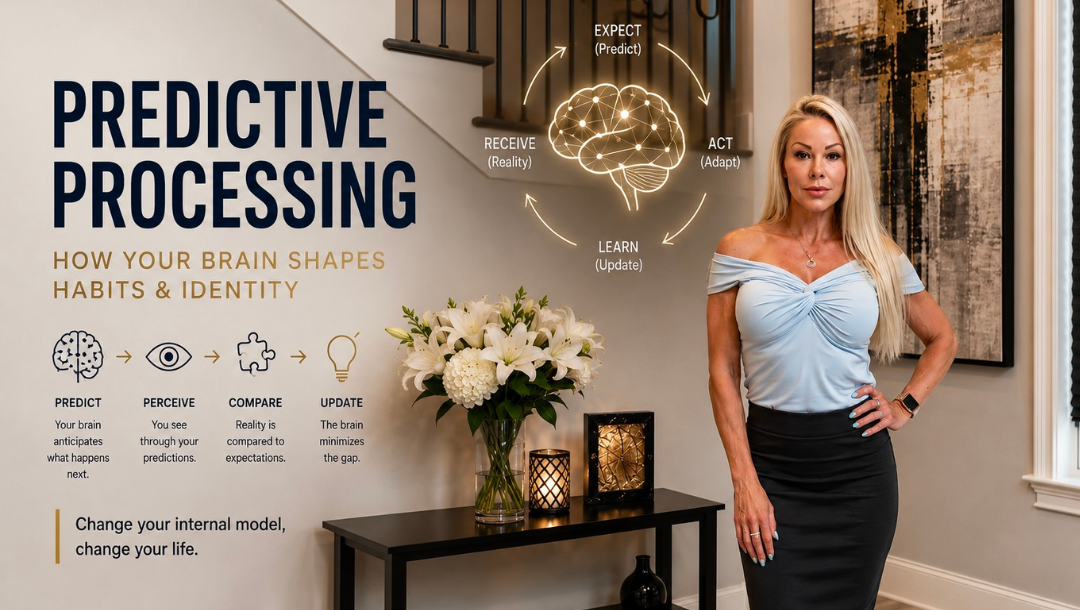
Have you ever wondered why lasting change feels so difficult? Why someone who genuinely wants to eat healthier still reaches for junk food… Why a person determined to exercise skips another workout… Or why people often fall back into old habits despite their best intentions? Most people assume it’s a lack of motivation or willpower. Modern neuroscience suggests something different. Your brain isn’t simply reacting to the world around you. Instead, it’s constantly predicting what will happen next, and those predictions shape what you perceive, how you feel, and how you behave. This concept, known as predictive processing, offers a powerful explanation for why lasting transformation requires more than changing behaviors. It requires updating the internal model your brain uses to predict your world.
What Is Predictive Processing?
Predictive processing is a neuroscience theory proposing that the brain continuously generates predictions about the world and compares them with incoming sensory information. Instead of passively observing reality, the brain actively constructs perception by updating, or defending, its internal model to minimize prediction errors. This process influences how we think, feel, perceive, and behave.
Rather than functioning like a camera that records reality exactly as it is, the brain works more like a scientist continuously testing hypotheses.
Every second, your brain asks:
“Based on everything I’ve learned, what am I about to experience?”
It then compares those predictions with information coming from your eyes, ears, muscles, organs, and other senses. Most of the time, what you consciously experience is a combination of sensory information and your brain’s expectations.
Internal Models in Predictive Processing
An internal model is the brain’s continuously updated representation of the world, built from your past experiences, memories, beliefs, emotions, expectations, habits, emotional associations, and identity. It acts as a mental blueprint that helps the brain predict what is likely to happen next, interpret incoming sensory information, and guide your thoughts, feelings, and behaviors in ways that are consistent with those predictions.
What Is the Free Energy Principle?
Predictive processing is closely related to the Free Energy Principle, proposed by neuroscientist Karl Friston. Although the mathematical theory is highly sophisticated, the central idea is basic. Living organisms strive to minimize prediction errors—the difference between what they expect and what they experience.
This doesn’t mean the brain tries to eliminate excitement or avoid surprises altogether. Instead, it continually works to reduce uncertainty by making increasingly accurate predictions about the environment based on past data. From an evolutionary perspective, organisms that could better predict their surroundings were more likely to survive. Predictability helped determine whether something represented food, safety, opportunity, or danger.
Predictive Processing at a Glance
- The brain predicts incoming sensory information before it arrives.
- Perception is not only shaped by sensory input but also by your expectations.
- The brain constantly compares predictions with reality.
- Differences between prediction and reality are called prediction errors.
- The Free Energy Principle suggests the brain works to minimize prediction errors and maintain a coherent internal model.
- Identity functions as one of the brain’s most stable predictive models.
- Habits emerge when behaviors align with those predictions.
- Lasting transformation requires updating your internal model, not simply forcing new behaviors.
What Do Predictive Processing, Internal Models, and the Free Energy Principle Mean for Your Life?
You may be wondering: “What do predictive processing, internal models, and the Free Energy Principle actually have to do with me?” The answer is: almost everything.
These concepts help explain why you tend to repeat the same habits, interpret situations in familiar ways, and often find lasting change so difficult. They influence how you perceive the world, make decisions, respond to stress, and even how you see yourself.
At the center of all three concepts is one simple idea: Your brain is constantly trying to predict what’s going to happen next.
To make those predictions, your brain relies on your internal model. Rather than starting from scratch every moment, your brain uses this model to anticipate what it’s about to see, hear, and experience. It isn’t simply reacting to the world around you. It’s constantly trying to predict what will happen next based on your past experiences, beliefs, emotions, and identity.
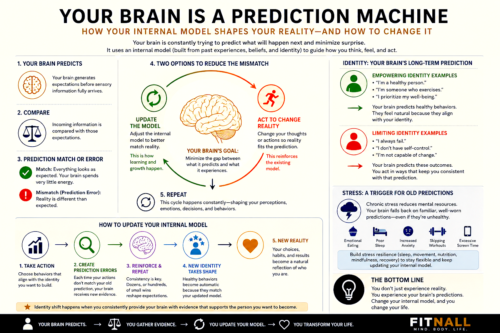
Your Brain Is a Prediction Machine
You probably think you first experience reality and then react to it. In many situations, your brain works the other way around. Before your senses fully process what’s happening, your brain has already generated a prediction about what it expects to experience. It then compares incoming information with those expectations.
If what you experience matches what your brain predicted, everything runs smoothly, and your brain uses very little energy. But when reality doesn’t match your expectations, your brain detects what’s called a prediction error.
At that point, it has two primary options:
- Update its internal model to reflect reality better.
- Change your thoughts or actions so reality becomes more consistent with its existing predictions.
In other words, much of your behavior can be understood as your brain’s ongoing effort to reduce the gap between what it expects and what it experiences.
One of the most fascinating aspects of predictive processing is that your brain doesn’t simply create an internal model; it actively protects it. This is why your beliefs about yourself matter so much.
If your internal model predicts, “I’m not good at sticking with healthy habits,” “I’m not athletic,” “I’m always stressed,” or “People don’t like me,” your brain is more likely to guide your thoughts and behaviors in ways that reinforce those expectations. At the same time, it often overlooks or minimizes evidence that contradicts them.
On the other hand, as you consistently gather evidence that supports a healthier identity, your internal model begins to change, and healthier behaviors start to feel more natural rather than forced.
Psychologists refer to this tendency as confirmation bias, but predictive processing suggests it may also be part of the brain’s fundamental strategy for maintaining a coherent model of the world.
Predictive Processing: You Perceive Your Predictions
Imagine you receive constructive feedback at work. You might see it as a valuable opportunity to learn and improve. Someone else, hearing the exact same feedback, might feel criticized, embarrassed, or rejected.
The difference isn’t necessarily the feedback itself. It’s the internal model each person’s brain uses to interpret it. Every experience you’ve had throughout your life has helped shape your internal model. Your memories, beliefs, emotions, habits, and identity influence what your brain expects to happen—and those expectations shape how you experience the world.
In other words, you don’t simply perceive reality as it is. You perceive reality through the lens of your brain’s predictions. Those predictions influence how you interpret situations, how you feel about them, and ultimately how you respond.
Predictive processing looks something like this:
Past experiences → Expectations → Perception → Emotions → Behavior
This is why two people can experience the same event yet walk away with completely different conclusions. It’s also why changing your life isn’t just about changing your actions; it’s about updating the internal model that shapes how you perceive yourself and the world around you.
Identity Is Your Brain’s Long-Term Prediction
Perhaps the most powerful prediction your brain makes is about who you are. Your identity is more than a label; it’s one of your brain’s most stable internal models. Over time, your experiences, beliefs, and repeated behaviors create a prediction about the kind of person you are and what you’re likely to do.
If you identify as:
- “I’m a healthy person.”
- “I’m someone who exercises.”
- “I prioritize my well-being.”
Your brain begins to expect behaviors that are consistent with that identity. Choosing nutritious foods, exercising, getting enough sleep, and managing stress become more natural because they align with your internal model. While these choices may still require effort, they no longer feel like you’re fighting against yourself.
But if your identity says:
- “I’m overweight—it’s just genetic.”
- “I always fail.”
- “I don’t have self-control.”
- “I’ve never been athletic.”
Your brain predicts those outcomes as well. Without realizing it, you’re more likely to notice evidence that supports those beliefs and make choices that reinforce them. It’s not because you’re lazy or lack willpower; it’s because your brain is trying to remain consistent with the identity it has learned to expect.
How Your Brain Changes Its Predictions
If your brain prefers consistency, how can you ever change? Predictive processing also involves prediction errors.
A prediction error occurs whenever reality doesn’t match what your brain expected. Although these mismatches create temporary uncertainty, they’re also one of the brain’s primary ways of learning.
Suppose your internal model says: “I’m not capable of exercising consistently.” That belief leads your brain to predict that you’ll eventually skip workouts or give up.
Now imagine you complete a workout. Nothing changes. But you’ve created evidence that contradicts your old prediction. Then you complete another workout. And another. One workout won’t rewrite years of experience, but dozens, or even hundreds, of repeated actions gradually reshape your internal model. Every time your actions don’t match your old identity, your brain receives new information.
However, trying to change behavior while leaving identity unchanged is like trying to change what appears on a computer screen without changing the underlying software. Eventually, the old program reasserts itself. This explains why people experience yo-yo dieting, repeated New Year’s resolutions, and cycles of motivation followed by relapse.
This is why lasting transformation isn’t just about changing what you do; it’s about changing what your brain expects from you. As your brain updates its predictions with new behaviors, you need to change the way you see yourself. Once you describe the type of person that you want to become, you can choose the actions that describe that person. Each healthy choice becomes evidence for a new internal model.
When you consistently provide your brain with evidence that supports a new identity, your brain gradually changes what it expects from you, and healthy behaviors begin to feel less like something you have to force and more like something that’s simply part of who you are.
This is why an identity shift is one of the most powerful drivers of lasting behavior change.
Stress: When Your Brain Falls Back on Old Predictions
If you’ve ever made great progress only to find yourself slipping back into old habits during a stressful time, you’re not alone, and it doesn’t necessarily mean you’ve failed.
When you’re under chronic stress, your brain has fewer cognitive and emotional resources available. Instead of building new predictions, it tends to rely on familiar ones. Even unhealthy habits can feel safer simply because they’re well-established and require less mental effort.
That’s why stressful periods often trigger emotional eating, poor sleep, increased anxiety, skipping workouts, excessive screen time, and other familiar unhealthy coping behaviors. They’re simply predictable.
One of the biggest mistakes you can make is interpreting a setback as proof of your identity. Missing a workout doesn’t mean you’re “someone who never sticks with exercise.” Eating an unhealthy meal doesn’t mean you’re “back to your old self.” Those are isolated events—not your identity.
Instead of viewing a relapse as evidence that your new identity isn’t working, think of it as your brain temporarily defaulting to an older, stronger prediction. This is a normal part of learning. The key is to recognize what’s happening, return to your healthy routines as soon as possible, and continue providing your brain with evidence that supports the person you’re becoming.
Over time, as your new habits accumulate, your healthier internal model grows stronger while the old one gradually loses its influence. Building resilience also gives your brain greater flexibility to update its predictions instead of automatically falling back on old patterns regularly.
Conclusion
The way you experience the world isn’t determined solely by what’s happening around you; it’s also shaped by the predictions your brain has learned to make. Your thoughts, emotions, habits, and behaviors are influenced by an internal model built from years of experiences, beliefs, and repeated actions. While this model helps you navigate life efficiently, it can also keep you stuck in patterns that no longer serve you.
The encouraging news is that your internal model isn’t permanent. Every time you make a choice that aligns with the person you want to become, you provide your brain with new evidence. One healthy meal won’t change your identity. One workout won’t erase years of old habits. But small, consistent actions repeated over time create the prediction errors your brain needs to update its model.
This is why lasting transformation is about consistently becoming the kind of person whose healthy choices feel natural because they align with who they are. Ask yourself regularly: “What evidence am I giving my brain about the person I’m becoming?” Every choice is a vote for your future identity.
The more often you act like the healthy, resilient, and capable person you want to be, the more your brain begins to expect those behaviors. Eventually, what once required conscious effort becomes part of who you are. That’s the power of predictive processing, and that’s why lasting change begins with changing your internal model, not just your behavior.
Ready to Update Your Internal Model?
The FITNALL App was built on the principles behind lasting behavior change. By combining personalized coaching with daily actions across fitness, nutrition, mindset, internal health, stress resilience, longevity, and lifestyle, it helps you consistently reinforce the identity of the healthy, resilient person you’re becoming—one small choice at a time.
Because the goal isn’t simply to change what you do. It’s to change who your brain predicts you are.
Frequently Asked Questions
Predictive processing is a neuroscience theory suggesting that the brain continuously generates predictions about the world and compares them with incoming sensory information. Instead of passively observing reality, the brain actively constructs perception using its internal model and updates it when prediction errors occur.
The Free Energy Principle, developed by neuroscientist Karl Friston, proposes that living organisms strive to minimize the difference between what they expect and what they experience. Reducing this uncertainty helps the brain maintain stability, adapt to changing environments, and support survival.
A prediction error is the difference between what the brain expects to happen and what actually occurs. These mismatches provide the information the brain uses to learn, adapt, and update its internal model.
Habits become easier to maintain when they align with your brain’s internal model or identity. If you see yourself as a healthy person, your brain is more likely to predict and support healthy behaviors. If your identity reinforces unhealthy patterns, your actions often follow those expectations.
Yes. Research in psychology and neuroscience suggests that lasting behavior change is more sustainable when it is rooted in identity rather than willpower alone. By repeatedly acting in ways that support a healthier self-concept, you provide your brain with evidence to update its predictive model.
You can gradually update your predictive model by consistently engaging in behaviors that align with the identity you want to build. Small, repeated actions—such as exercising regularly, eating nutritious foods, practicing mindfulness, and keeping promises to yourself—provide evidence that reshapes your brain’s expectations over time.
To a Fitter Healthier You,
Mind-Body Optimization Specialist
About the Author
Adriana Albritton is a Mind-Body Optimization Specialist and the founder of FitnAll Coaching. She developed the FITNALL Method, a holistic framework that integrates fitness, internal health, thought patterns, nutrition, adaptation, longevity, and lifestyle habits to support sustainable fat loss and long-term wellness. Adriana is the author of 28 Days to a New Life: A Holistic Program to Get Fit, Delay Aging, and Enhance Your Mindset. She speaks and writes about holistic performance, longevity, and the integration of mind and body for optimal health.