

We often think of the mind and body as separate systems. We exercise to strengthen the body, meditate to calm the mind, improve our diet to support physical health, and seek therapy to address emotional struggles. But what if these systems were never truly separate? The teachings of Carl Jung offer a powerful perspective on the relationship between our inner and physical worlds. Jung explored how unconscious thoughts, emotional conflicts, fears, and unresolved aspects of the psyche can shape our experiences, reactions, and behaviors. Understanding this unconscious influence on mind and body, while recognizing the continuous, bidirectional relationship between mental and physical health, can deepen self-awareness and be a path to individuation and healing.
Long before the term mind-body connection became commonplace in wellness and psychology, Swiss psychiatrist Carl Jung explored the profound relationship between our conscious thoughts, unconscious patterns, emotions, and physical experience.
Jung’s work suggests that becoming healthier and more whole isn’t simply about changing what we do on the outside. It also requires becoming aware of what is happening within us and achieving individuation. This idea is increasingly relevant today as research continues to examine the relationships among psychological stress, emotional regulation, the nervous system, behavior, and physical health.
Jung’s Views of the Mind and Body
Carl Jung rejected an overly simplistic separation between psychological and physical experience since the body can serve as a communicator of unconscious material.
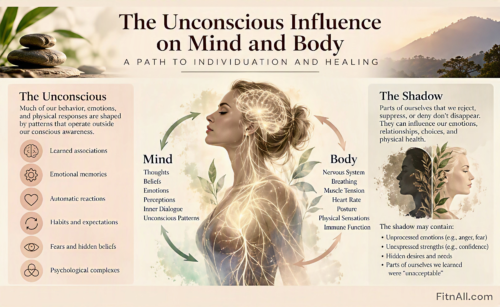
Emotional reactions are not merely abstract thoughts occurring somewhere inside the brain. They are also experienced through changes in breathing, muscle tension, heart rate, posture, sensations, biofield, and other physiological responses.
Jung’s early research into psychological complexes was especially revealing. He observed physiological changes associated with emotionally charged material, contributing to his understanding that unconscious psychological processes could have bodily expressions.
From this perspective, the body isn’t merely something we carry around while the mind runs the show. It participates in our experience, illuminating the unconscious influence on mind and body.
The Influence of the Unconscious on Mind and Body
One of Carl Jung’s greatest contributions to psychology was his exploration of the unconscious.
We like to believe that our decisions are entirely rational and deliberate. Yet much of human behavior is shaped by learned associations, emotional memories, automatic reactions, habits, fears, expectations, predictive processing, and patterns that operate outside immediate conscious awareness.
You may consciously want one thing while repeatedly behaving in ways that produce something completely different.
For example:
- You want a healthy relationship but repeatedly choose emotionally unavailable partners.
- You want to become healthier, but you interrupt your routines whenever progress begins, or you keep identifying with an illness diagnosis.
- You want professional success but continually procrastinate or sabotage opportunities that appear.
- You want peace but remain psychologically attached to situations that generate stress.
Jungian psychology encourages us to become curious about these contradictions rather than simply criticizing ourselves for them. Instead of asking: “What’s wrong with me?” We can ask: “What pattern is operating here?” The question creates space for awareness. And awareness creates the possibility of change.
The Shadow
Another important concept is what Carl Jung called the shadow. The shadow represents aspects of ourselves that we reject, suppress, deny, or fail to recognize.
These parts of ourselves aren’t necessarily negative. The shadow might contain anger or jealousy, but it can also contain confidence, assertiveness, creativity, sexuality, ambition, or strength that we learned somewhere along the way was unacceptable.
Suppressing these parts doesn’t necessarily make them disappear. Instead, they may influence our emotions, relationships, choices, and behavior outside conscious awareness. This is why genuine self-development involves more than positive thinking.
Sometimes growth requires examining uncomfortable parts of ourselves:
- What triggers you?
- What do you repeatedly avoid?
- What qualities in other people produce unusually strong reactions?
- What emotions do you refuse to allow yourself to feel?
- What patterns keep appearing in your life?
These questions can reveal psychological material that deserves attention.
Individuation: Becoming a More Integrated Human Being
When you include the suppressed in your internal dialogue, you are participating in individuation, which is at the center of Carl Jung’s psychology.
Individuation refers to the process of integration: unifying the self, the conscious and unconscious aspects of ourselves, and becoming a more psychologically whole, authentic individual. Rather than constructing an idealized version of ourselves, we gradually become more aware of who we actually are.
That means integrating apparent opposites such as strength and vulnerability, logic and emotion, conscious intention and unconscious motivation, achievement and rest, and mind and body.
The Library of Congress describes Jung’s individuation as the integration of conscious and unconscious elements of personality toward greater wholeness and self-realization. The objective is wholeness, not perfection.
Your Body: Fast Responder and Informational Mine
Many times, your body responds before your conscious mind does, offering a powerful illustration of the unconscious influence on mind and body. Think about what happens when you encounter something threatening. Your heart may race. Your muscles tighten. Your stomach contracts. Your breathing changes. Sometimes these responses occur before you have consciously processed what is happening.
The same principle can apply more subtly to emotional experiences. A conversation might produce tension in your shoulders. Thinking about a stressful situation may create a knot in your stomach. Being around a particular person might change your breathing or posture without you consciously noticing it.
These sensations demonstrate something important: Your body participates in emotional experiences, and learning to notice those signals can increase self-awareness.
Knowing this, you can treat your body as an informational mine. Your body is constantly providing clues about what is happening beneath conscious awareness. Changes in muscle tension, breathing, heart rate, energy, posture, and physical sensations can reveal stress, emotional reactions, unmet needs, and recurring patterns before the conscious mind has fully recognized them.
Unfortunately, modern life encourages us to live largely inside our heads. We analyze, plan, scroll, work, worry, and think. Meanwhile, we often ignore what the body is communicating until something becomes impossible to overlook.
Being more mind-body conscious involves developing greater interoceptive awareness, the ability to notice sensations arising within the body. Learning to tune into physical signals turns the body into a powerful source of information, helping us recognize patterns, regulate our responses, and make choices that better support our physical and emotional well-being.
Being more aware of the unconscious influence on mind and body, you might occasionally ask:
- Where am I holding tension?
- Has my breathing become shallow?
- What happens in my body when I think about this situation?
- Do I feel open and relaxed, or contracted and guarded?
- What was running through my mind before I got that migraine, backache, or coughing fit?
Jung and Healing
Carl Jung’s work with patients led him to recognize the profound unconscious influence on mind and body and how mental and physical suffering can sometimes involve unconscious conflicts that a person has not yet brought into awareness. Thoughts, fears, emotional wounds, self-judgments, and rejected parts of ourselves may continue influencing how we feel and behave even when we don’t consciously recognize them.
Jung did not believe that awareness alone magically cures illness; rather, he saw healing as a process of bringing unconscious material into consciousness and integrating the conflicting parts of the self.
This changes the inner conversation. Instead of continually fighting, judging, or berating ourselves, we can begin listening to what lies underneath those reactions. When we meet our fears, wounds, imperfections, and physical sensations with curiosity rather than hostility, we create an opportunity for greater self-understanding, self-compassion, and emotional regulation. In this sense, self-love is about ending the internal war and learning to relate to the whole self with greater acceptance and care.
Paths to Individuation
You don’t need to undergo Jungian analysis to become more aware of the relationship between your inner and outer worlds and achieve wholeness and individuation. Start with simple practices.
Bring the Unconscious Into Awareness
You can’t intentionally change a pattern you can’t see. Once you recognize your patterns, psychological and physical, you gain an opportunity to respond rather than automatically react. That small space between awareness and reaction is where change and individuation become possible.
Observe Recurring Patterns
- Look for situations, relationships, or behaviors that repeatedly produce similar outcomes. Recurring patterns can reveal unconscious beliefs, emotional triggers, or unresolved conflicts that continue shaping your choices and reactions without your awareness.
Name What You’re Feeling
- Instead of immediately suppressing an uncomfortable emotion, identify it. Anger, fear, sadness, resentment, excitement, and anxiety all provide information.
Journal or Reflect
- Writing can help bring unconscious or poorly defined thoughts and emotions into conscious awareness. It also creates space to recognize unhealthy patterns, cognitive distortions, question limiting beliefs, and explore what your emotions and inner dialogue may be trying to communicate.
Notice Your Physical Reactions
- Pay attention to your breathing, posture, tension, energy, and other bodily responses during emotionally significant situations. These physical signals can offer valuable clues about emotions, stress, or unconscious patterns that your conscious mind has not yet fully recognized.
Make Room for Stillness
- Constant stimulation makes it difficult to notice what is happening internally. Meditation and moments of quiet allow you to turn your attention inward and observe subtle thoughts, emotions, and bodily sensations.
These moments of recognition help bring automatic and unconscious patterns into awareness, creating an opportunity to respond more intentionally instead of simply reacting.
Change Your Inner Dialogue
From Carl Jung’s perspective, inner dialogue is not simply about replacing negative thoughts with positive ones. It is about listening to what arises within us—our fears, judgments, emotions, recurring thoughts, and rejected parts—and bringing those unconscious patterns into conscious awareness. Once we can observe the inner voice instead of automatically believing or fighting it, we gain the opportunity to change our relationship with ourselves and influence our emotional and physiological state.
Your internal dialogue can affect your emotional responses, behavioral choices, and how threatening or manageable a situation feels. Continually reinforcing thoughts of helplessness, inadequacy, danger, or failure can keep you psychologically focused on threat. This doesn’t mean pretending everything is wonderful. It means becoming conscious of the mental narratives you repeatedly reinforce.
Consider the difference between repeatedly thinking: “I’m going to fail” and “This is difficult, but I can figure out my next step.” The circumstances haven’t changed, but your interpretation of them and your attitude have.
Ask yourself: Is the way I’m speaking to myself helping me respond effectively to my life or keeping me trapped in an old pattern? Replacing relentless self-criticism with curiosity, compassion, exuberance, and self-respect can help create a healthier internal environment for both psychological and physical well-being.
Move Your Body and Connect to the Earth
Earthing, exercise, yoga, walking, stretching, and other forms of movement can shift both physical and psychological states. Intentional movement and having physical contact with the earth’s surface can also help release physical tension, regulate stress, improve mood, and reconnect you with bodily sensations that may otherwise go unnoticed.
Use Breath Intentionally
Breathing exercises can be a simple way to influence physiological arousal and reconnect attention with the body. By consciously slowing the breath, you can help shift the nervous system toward a calmer state, creating greater space to observe your thoughts, emotions, and physical sensations without immediately reacting to them.
Allow Healing to Take Place
Jung’s ideas remind us that health is about more than eliminating symptoms or improving individual parts of ourselves. It’s about integration, since we are interconnected systems.
Our thoughts affect our emotions. Our emotions affect our bodies. Our physical state influences our thoughts. Our habits influence our biology. Our relationships influence our nervous system. Our environment influences our behavior. Everything interacts.
Healing can begin when we bring unconscious thoughts, beliefs, and emotional patterns into awareness and recognize the unconscious influence on mind and body, including how these hidden patterns may shape our physical sensations and responses.
Instead of automatically reacting to tension, fear, discomfort, or stress, we can become curious about what the body may be communicating and address the underlying patterns contributing to our experience.
Healing also involves changing the way we relate to ourselves. When we stop berating, criticizing, and fighting ourselves and instead allow ourselves to feel our emotions with compassion, we create space for greater emotional regulation and inner safety. Practicing self-love means meeting ourselves with acceptance, respect, patience, and care while making choices that support our psychological and physical well-being and individuation.
Final Thoughts: From Unconscious Patterns to Wholeness
Carl Jung’s teachings invite us to look beneath the surface of our thoughts, emotions, behaviors, and physical responses and become curious about what may be operating outside our conscious awareness. Understanding the unconscious influence on mind and body allows us to recognize patterns that may have been shaping our experiences without our realization.
The path to individuation is not about becoming perfect or rejecting the parts of ourselves we don’t like; it is about bringing more of ourselves into awareness and integrating our fears, strengths, wounds, desires, conscious intentions, and unconscious patterns into a more authentic, aligned, and whole self.
Perhaps one of the most valuable lessons we can take from Carl Jung on healing is that transformation does not come from fighting ourselves but begins by listening to ourselves. When we pay attention to the body’s signals, examine recurring patterns, question our inner dialogue, allow ourselves to feel, and replace self-judgment with curiosity, compassion, and self-love, we create space for greater integration and healing.
Ultimately, individuation is a journey toward wholeness: the more of ourselves we are willing to bring into the light, the less we are unconsciously controlled by what remains in the dark.
To a Fitter Healthier You,
Mind-Body Optimization Specialist
About the Author
Adriana Albritton is a Mind-Body Optimization Specialist and founder of FitnAll Coaching. She developed the FITNALL Method, a holistic framework that integrates fitness, internal health, thought patterns, nutrition, adaptation, longevity, and lifestyle habits to support sustainable fat loss and long-term wellness. Adriana is the author of 28 Days to a New Life: A Holistic Program to Get Fit, Delay Aging, and Enhance Your Mindset. She speaks and writes about holistic performance, longevity, and the integration of mind and body for optimal health.