
Getting stronger takes more than lifting heavier weights whenever you enter the gym. Your body needs a consistent training stimulus, exercises suited to your goals, and enough recovery to adapt. Learning how to build strength means understanding how these pieces work together. Whether you’re starting strength training or trying to move past a plateau, the following seven principles will help you train with greater purpose, monitor your progress, and develop strength you can use in the gym and everyday life.
How Do You Build Strength?
To build strength, practice resistance exercises consistently, use controlled technique, and gradually increase the challenge as your performance improves. Follow a program that matches your experience and goals, rest sufficiently between demanding sets, and support your training with adequate nutrition, hydration, and sleep.
1. Follow a Strength Training Plan and Use Progressive Overload
A structured program gives your workouts direction. Choose exercises, repetition ranges, and a weekly schedule that you can follow consistently rather than changing your routine every session.
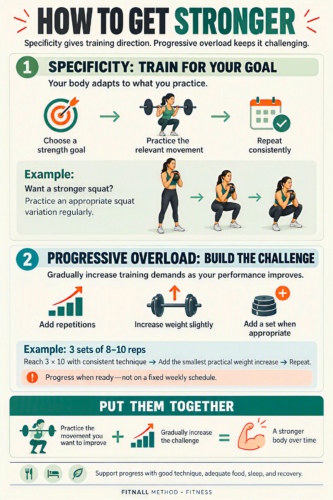
The principle of specificity means that your improvements reflect what you practice. If your goal is a stronger squat, for example, regularly practicing an appropriate squat variation helps develop both strength and skill in that movement.
Beginners can build strength with moderate weights while learning technique. As experience develops, heavier sets with fewer repetitions can help improve maximal strength. You don’t need to attempt your heaviest possible lift to make progress.
Progressive overload means gradually increasing training demands as your body adapts. You might add a repetition, increase resistance slightly, or complete the same work with better control.
- Suppose your program calls for three sets of 8–10 repetitions. Start with a weight you can control throughout each set. Once you can complete all three sets at the upper end of the range with consistent technique and some effort remaining, increase the weight by the smallest practical amount.
There is no requirement to increase weight every week. Let your performance guide progression.
2. Develop Consistent Exercise Technique
Good technique helps you practice the movement you intend to strengthen. Choose a load that allows you to maintain balance, control the weight, and use a range of motion appropriate for your body and the exercise.
Before increasing resistance, ask yourself:
- Can I maintain my position throughout the set?
- Am I controlling the movement rather than relying on momentum?
- Can I repeat the exercise consistently?
- Does the movement feel comfortable rather than painful?
Technique can vary with anatomy, mobility, equipment, and training goals. A qualified trainer can help you find a suitable setup and recognize when a weight is too demanding.
If an exercise causes sharp, worsening, or persistent pain, stop that movement and seek appropriate guidance. Many chiropractic care services can help, but proper form is crucial.
3. Build Your Routine Around Major Movement Patterns
Compound exercises involve multiple joints and muscle groups, making them useful foundations for strength training.
Include suitable variations of these movements across your program:
- Squat: goblet squat, back squat, or leg press.
- Hip hinge: Romanian deadlift or another appropriate deadlift variation.
- Push: push-up, chest press, or shoulder press.
- Pull: dumbbell row, seated cable row, or lat pulldown.
You don’t have to perform every movement in every workout. Distribute them across your week according to your schedule and recovery.
Isolation exercises also have value. Curls, triceps extensions, leg curls, and similar movements can complement your main lifts and help address specific goals. Choose exercises you can perform consistently and progress over time.
4. Fuel Your Training and Stay Hydrated
Building strength requires enough energy to train productively and recover afterward. Learn macronutrient strategies and include protein-rich foods throughout the day, carbohydrates to support training, and dietary fats from varied sources.
A meal or snack before exercise may help you feel energized, depending on its size and your digestive comfort. After training, continue your normal eating pattern and include protein in a meal or snack. Avoid treating a narrow post-workout window as the deciding factor in your results.
Build meals around foods such as eggs, fish, poultry, beef, beans, kefir, whole grains, vegetables, fruit, nuts, and seeds. If you consistently under-eat, you may limit your ability to progress, and your workouts may feel harder.
Stay hydrated by keeping in mind that hydration needs vary. Consider workout duration, heat, sweat losses, and how you feel rather than following one fixed fluid prescription for every session.
5. Give Yourself Enough Recovery
Training provides the challenge; recovery supports the adaptations that follow. More exercise is not automatically more productive. Schedule demanding sessions along with rest days so that the muscles involved have time to recover. Your needs will depend on workout intensity, training volume, experience, sleep, and other sources of stress.
Rest between sets matters, too. Allow enough time to perform the next set with the intended effort and technique. Heavy compound exercises often require longer breaks than lighter accessory movements.
Prioritize consistent sleep and adjust training when fatigue accumulates. If performance repeatedly declines, consider whether you need less training volume, additional rest, or a lighter week.
6. Warm Up for the Exercises You’re About to Perform
An effective warm-up prepares you for your planned workout without leaving you exhausted. Begin with a few minutes of comfortable movement, then practice the relevant movement patterns. Before a demanding lift, perform progressively heavier warm-up sets while keeping the repetitions manageable.
For example, before working sets of squats, you might perform bodyweight squats, practice with an empty bar, and gradually add weight. The purpose is to prepare your movement, coordination, and effort—not simply to sweat as much as possible.
7. Track Progress and Address Your Weak Points
Keep a simple training log of exercises, weights, repetitions, sets, and how challenging the work feels. This helps you recognize improvement and identify patterns when progress slows.
If a lift stalls, review the basics before adding more exercises:
- Are you practicing it consistently?
- Is the weight appropriate?
- Are you resting enough between sets?
- Has your technique changed?
- Are sleep, nutrition, or stress affecting performance?
Targeted accessory exercises can help address specific limitations, but the choice should reflect the actual problem. A sticking point may involve technique, positioning, fatigue, or strength. Also think about exercises such as isometrics, which are a wonderful way to send signals to those muscles and improve the mind-muscle connection. So if you have a specific sticking point in an exercise, you could use isometrics at that point, and rest, before coming back to it.
Progress can also mean completing more controlled repetitions, feeling steadier, or performing everyday tasks with greater ease.
Final Thoughts
Building strength takes consistent training, controlled technique, gradual progression, and adequate recovery. By applying these seven principles, you can give your workouts purpose and create the conditions for steady improvement. Track your progress, adjust your plan when needed, and remember that getting stronger is a long-term process supported by your daily habits.
Strength development fits within the Fitness pillar of the FITNALL Method, but your results are also influenced by nutrition, stress adaptation, internal health, and daily habits. A demanding workout cannot compensate indefinitely for inadequate food, disrupted sleep, or an unsustainable schedule. Bringing these areas together helps you build a routine you can maintain.
The FITNALL App brings together personalized workouts, nutrition support, mindset coaching, and lifestyle guidance to help you put these principles into practice and stay consistent with your goals.
Frequently Asked Questions
Yes. Beginners can develop strength with manageable resistance while learning movement technique. Gradually increasing the challenge matters more than attempting maximum weights early.
No. Increase resistance when you can complete your planned work with consistent technique and appropriate effort. Some weeks, progress means adding repetitions or improving control.
Yes. Dumbbells, resistance bands, and bodyweight exercises can build strength when they provide sufficient challenge. Your equipment may eventually limit progression in particular movements.
Strength is the ability to produce force, while muscle growth means increasing muscle size. They overlap, but strength also depends on movement skill, coordination, and nervous-system adaptations.
Common reasons include inconsistent training, insufficient progression, accumulated fatigue, inadequate nutrition, or a program that does not match your goals. Review your training log and recovery habits before assuming you need harder workouts.
To a Fitter Healthier You,
Mind-Body Optimization Specialist
About the Author
Adriana Albritton is a Mind-Body Optimization Specialist and founder of FitnAll Coaching. She developed the FITNALL Method, a holistic framework that integrates fitness, internal health, thought patterns, nutrition, adaptation, longevity, and lifestyle habits to support sustainable fat loss and long-term wellness. Adriana is the author of 28 Days to a New Life: A Holistic Program to Get Fit, Delay Aging, and Enhance Your Mindset. She speaks and writes about holistic performance, longevity, and the integration of mind and body for optimal health.