Mindset and behavior are at the core of everything you do, your goals, habits, relationships, health, and success. Yet most people don’t realize that the patterns driving their thoughts and actions can be intentionally reshaped. This is where Neuro-Linguistic Programming (NLP) becomes a powerful tool. NLP helps you change how you think, feel, and respond to challenges with its practical, science-backed techniques. By understanding and reprogramming your internal patterns, you can break limiting beliefs, reshaping internal dialogue, build confidence, improve communication, strengthen motivation, and upgrading the way you think and act in everyday life. In this article, you’ll discover the top NLP techniques for mindset and behavior change. These methods are simple, effective, and can be used by anyone seeking to upgrade their thinking and take control of their life.
Well-Formed Outcomes: Set Goals Your Mind Can Achieve
Vague goals lead to vague results because your unconscious mind can’t act on them. Well-Formed Outcomes are one of the most effective NLP techniques for mindset and behavior change. It helps you turn vague intentions into clear, achievable goals. With Well-Formed Outcomes, you define the exact result you want and create a mental blueprint your unconscious mind can follow.
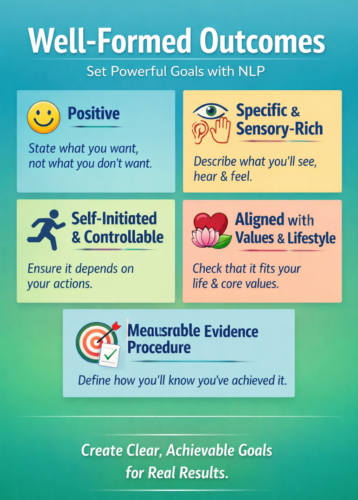
A well-formed outcome must be:
- Positive
- Specific and sensory-rich
- Self-initiated and controllable
- Aligned with your values and lifestyle
- Measurable with a clear evidence procedure
Well-Formed Outcome for Weight Loss & Better Health Example
Most people say, “I want to lose weight” or “I want to get healthier.” But these goals are vague, emotionally flat, and hard for the unconscious mind to act on. With NLP, we turn these vague desires into actionable goals with a built-in success roadmap and a Well-Formed Outcome.
Here’s a real-life example using the NLP criteria:
State the Goal Positively
- Instead of “I don’t want to be overweight anymore,” or “I need to stop eating junk food,”
✔️ “I want to feel lighter, stronger, and healthier in my body.” - Your unconscious mind works better with positive commands, so you describe what you want, not what you want to avoid.
Make It Specific and Sensory-Rich
- ✔️ “I see myself waking up with more energy, moving easily throughout the day, and choosing nourishing foods. I hear myself speaking kindly about my body. I feel confident, proud, and comfortable in my clothes.”
- By engaging the senses, you tell your unconscious mind exactly what “healthier” looks and feels like. Now your mind has a detailed representation to follow.
Make It Self-Initiated and Controllable
- ✔️ “I will walk 30 minutes daily, strength-train 3 times a week, prepare simple healthy meals, and practice portion awareness.”
- The goal should depend on your behavior, not outside factors. These actions are completely under your control.
Check Ecology: Does It Fit Your Life and Values?
- ✔️ “Feeling stronger and healthier supports my values of well-being, confidence, and long-term vitality. It fits my lifestyle and improves every other area of my life.”
- Ask yourself, does this goal align with my values? Does it support my lifestyle? Is there any conflict? Now the unconscious mind has no resistance.
Evidence Procedure: How Will You Know You’ve Succeeded?
- ✔️ “I’ll know I’m achieving this outcome when I consistently move my body, follow my nutrition plan, and naturally maintain a lower weight. I’ll measure progress by feeling more energetic, lifting heavier weights, improving my sleep, and noticing changes in how my clothes fit.”
- This gives the brain a clear finish line.
⭐ Final Well-Formed Outcome Example
“I want to feel lighter, healthier, and stronger in my body. I will walk 30 minutes each day, strength-train three times a week, and prepare simple, nourishing meals that fuel my energy. I see myself waking up refreshed, moving comfortably, and feeling confident in my clothes. I will track my progress weekly and celebrate each improvement. This supports my values of health, vitality, and self-care. I will know I’m successful when I consistently follow this routine for 8 weeks, feel more energetic, and see improvements in strength, mood, and overall well-being.”
Reframing: Change the Meaning, Change the Outcome
Reframing is one of the foundational NLP techniques for mindset and behavior change. It helps you shift your perspective. It involves changing the meaning you assign to an experience so you can view it in a more empowering way.
Rather than interpreting a setback as a failure, reframing encourages you to see it as:
- Feedback
- A lesson
- A necessary step toward mastery
This shift reduces emotional resistance, lowers stress, and opens the door to more flexible, resourceful thinking. Reframing helps you transform obstacles into opportunities and allows you to respond instead of react.
Anchoring: Create Instant Access to Empowering States
Anchoring is a NLP technique for mindset and behavior change. It links a specific physical gesture or cue to a desired emotional state, allowing you to attach a desired emotional state, such as confidence, motivation, calm, or focus, to a physical gesture or cue.
This technique gives you immediate access to your strongest internal resources, exactly when you need them. Once established, the anchor becomes a mental shortcut: Touch the anchor → Activate the emotional state.
Anchoring works because your brain constantly forms associations. Just as a song can trigger a memory, an anchor triggers a powerful emotional state. NLP uses this natural mechanism deliberately to help you gain emotional control and confidence on demand.
How to Create a Powerful Anchor
- Choose Your State: Choose the state you want to recreate in the future – confidence, calm, motivation, etc.
- Recall a Peak Experience: Think about a time where you felt that state intensely.
- Amplify the Feeling: Focus on that feeling until it reaches its peak.
- Set the Anchor: Choose the physical gesture or cue – press fingers together, tap wrist, etc.
- Break the State: Get yourself out of that state by moving, opening your eyes, or shifting focus.
- Test the Anchor: Practice your anchoring regularly to strengthen the connection until the emotional response becomes automatic.
Anchoring is incredibly useful for public speaking, workouts and performance goals, stressful situations, and overcoming self-doubt or anxiety. Make sure to use the anchor proactively to prepare for high-pressure moments
- For example, you can create an anchor for confidence by pressing your thumb and forefinger together during a peak moment of self-assurance, then use that same gesture later to quickly trigger the confident feeling.
Submodalities: Rewire the Emotional Impact of Your Thoughts
Submodalities refer to a NLP technique for mindset and behavior change, which focuses on the sensory qualities of your experiences, such as brightness, size, distance, volume, texture, temperature, and more. By changing the sensory qualities of your internal images, sounds, and feelings, you can change how you feel about a memory or thought.
By bringing to the forefront sensory qualities, you instantly shift your emotional state. These small internal adjustments help your mind detach from negative patterns and strengthen empowering ones. Submodality shifts help reprogram thought patterns at a deep unconscious level, often producing rapid emotional relief.
- For instance, by making a stressful mental picture smaller, dimmer, or farther away, you can reduce fear or panic. By turning up the brightness and clarity of a positive goal, you can increase motivation. And by softening a harsh inner voice, you reduces anxiety or shame.
Timeline Technique: Rewrite Your Past and Future Pathways
Another NLP technique for mindset and behavior change is timeline. It focuses on how your mind organizes past memories and future expectations along an internal “timeline.” By shifting the way you store these events, you can release emotional baggage, resolve internal conflicts, eliminate limiting beliefs, strengthen motivation and direction, and create a compelling, empowered future.
Timeline NLP helps you stop dragging the past into the present, and start stepping into a future intentionally designed by you. It is especially effective for individuals struggling with fear, regret, or uncertainty about the future.
Step-by-Step Timeline NLP Exercise
Identify Your Internal Timeline
- Most people naturally visualize the past on one side and the future on the other. You might feel the past behind you, to your left, or even above you. Everyone is different.
- Ask yourself: “Where is my past located when I think about it?” “Where is my future?”
Choose a Past Event You Want to Release
- Pick a memory that still evokes stress, fear, regret, or tension — something that emotionally weighs you down.
- For example: A time you were embarrassed publicly or you made a mistake at work.
Float Above Your Timeline
- Close your eyes and imagine yourself gently floating above your timeline, like you’re observing your life from a neutral, bird’s-eye view.
- This creates emotional distance.
Move to a Position Before the Event Occurred
- Imagine floating to a spot before the event happened, before you even knew it would take place.
- From this vantage point, notice how the emotion softens because the experience hasn’t happened yet in that point of observation.
Reinterpret the Experience
- Ask empowering questions: “What learning did this event give me?” “How did it help me grow?” “What strength did I gain from it?”
- Reframe the meaning so the memory becomes useful instead of draining.
Return to Your Timeline With a New Perspective
- Now float back down into the present moment, bringing the new interpretation with you. Notice how the emotional charge has changed and become significantly reduced.
Future Pace Your New Mindset
- Imagine moving forward along your timeline into a future situation where you would normally feel fear or hesitation. Now see yourself responding with confidence, clarity, or calm.
- This installs the new emotional response into your future behavior.
Visualization & Mental Rehearsal: Train Your Mind for Success

Visualization is one of the most effective NLP techniques for mindset and behavior change. It shapes the brain’s expectations. By mentally rehearsing success in vivid, sensory-rich detail, you prime your nervous system to behave in alignment with your goals.
Research shows that visualization has a measurable impact on real-world performance. One study found that athletes with stronger mental imagery skills consistently achieved higher levels of performance, demonstrating that mental rehearsal enhances confidence, skill execution, and overall outcomes. Additional neurological evidence reveals that visualization activates many of the same neural pathways involved in actual movement and behavior. This means the brain responds to imagined experiences similarly to real ones, strengthening neural connections, improving focus, and priming the body for success. Together, these findings highlight why visualization is such a powerful tool for accelerating growth and achieving goals.
Athletes, performers, and high achievers use visualization to “practice” success before it happens. When you repeatedly imagine yourself succeeding vividly -seeing it, hearing it, feeling it- your brain begins to treat the scenario as familiar and achievable. Visualization helps you enhance confidence, reduce anxiety, improve performance, and strengthen motivation.
How to Strengthen Your Visualization
The more detailed and realistic the mental rehearsal, the stronger the emotional and neurological imprint it creates. Therefore, when you visualize, engage all your senses.
Bring it to life by focusing on:
- What do you see?
- What do you hear?
- What do you feel internally?
- What sensations surround you?
Modeling: Learn from Those Who Already Succeed
Modeling is a core NLP technique for mindset and behavior change based on one idea that success leaves clues. By identifying and replicating the mindset, behaviors, and strategies of someone who excels in the area you want to improve, you can achieve results faster and with more confidence.
Modeling allows you to shorten your learning curve by adopting proven success patterns instead of relying on trial and error.
Step-by-Step Modeling Exercise
Choose a Role Model
- Pick someone who is already successful in the skill or behavior you want to improve. You can model public speakers, athletes, business leaders, communicators, or anyone demonstrating excellence. This person can be someone you know personally, a public figure, or even a fictional character.
Observe Their Behavior
Look for specific, repeatable behaviors and ask yourself:
- How do they carry themselves?
- What is their body language like?
- How do they speak?
- How do they respond under pressure?
- What habits or routines do they follow daily?
Identify Their Thought Patterns
The most powerful part of Modeling is understanding the mindset behind the behavior. You may not know all the answers, but you can make educated guesses based on how they act.
Ask yourself:
- What do they believe about themselves?
- How do they view challenges?
- What do they focus on when things get hard?
- What is their internal dialogue like?
- What emotions do they access in key moments?
Break It Down Into Skills or Strategies
- Modeling works best when you break what you observe into small pieces.
- For example, if you are modeling a confident speaker, you’ll identify that they prepare thoroughly, practice their tone and pacing, make strong eye contact, use controlled breathing, visualize success beforehand, and focus on serving the audience, not performing.
- These are all strategies you can replicate.
Practice Acting “As If”
- This is where transformation begins. Imagine stepping into the mindset and behaviors of the person you’re modeling.
- Throughout your day, ask: “How would they handle this situation?” and “What choice would they make right now?” Then act in alignment with that.
Try It in a Real-Life Scenario
- Choose one challenge where you’ll apply the modeled behaviors.
- For example, if you’re nervous about a meeting, ask: “How would my confident role model speak?” “How would they sit or stand?” “What would they focus on mentally?”
- Then follow that blueprint during the meeting. You’ll be shocked how quickly your emotional state shifts.
Refine and Adjust
After each attempt, reflect:
- What worked well?
- What felt natural?
- What felt forced?
- What should I model more closely next time?
When you adopt role models’ successful strategies consistently, you implement new possibilities – not through willpower but through modeling success patterns.
Future Pacing: Install New Behaviors for Real-Life Success
Future pacing helps you mentally step into a future scenario where you’ve successfully achieved your goal. By imagining the future in vivid sensory detail, you “install” the new behavior into your unconscious mind.
For example, if you’re working on confidence, you might imagine:
- Walking into a meeting self-assured
- Speaking clearly
- Feeling calm and grounded
- Receiving positive reactions
This technique strengthens follow-through and helps your brain accept the new version of you as reality.
Swish Patterns: Replace Negative Habits with Empowering Ones
Swish Patterns are an NLP technique for mindset and behavior change designed to replace an unwanted thought, habit, or emotional reaction with a new, empowering one. The goal is to train your brain to automatically move toward the behavior you want instead of the one you’re trying to eliminate. Over time, your mind automatically shifts toward the positive behavior.
This technique is especially effective for procrastination, cravings, stress triggers, and negative thinking patterns.
Step-by-Step Swish Pattern
Below is an easy, real-life example if you want to stop procrastinating:
Identify the Trigger Image
- Think about the moment right before you procrastinate. What image pops into your mind? For example you see yourself slouched on the couch, scrolling your phone, avoiding the task.
- This is your “unwanted image.”
Create a New Empowering Image
- Now imagine yourself taking action confidently. See yourself sitting upright, focused, working with energy and clarity.
- This is your “desired image.” Make the new image: bright, close, colorful, big, and powerful.
Set Up the Swish
- Hold the unwanted image in your mind fully.
Then place a small, dim version of the empowering image in the corner—almost like a thumbnail.
The Swish!
Now quickly SWISH. This should happen in less than one second—almost like snapping your fingers.
- Make the empowering image grow bigger, brighter, closer
- Simultaneously make the unwanted image shrink, fade, and disappear
Break the State
- Look around the room, take a breath, move your body, or think of something random and unrelated. This prevents the mind from blending images.
Repeat 5–7 Times
- Each time, increase the speed and intensity of the swish. By the final repetition, the old image should feel weaker, faded, or disconnected—while the new empowering image feels strong and natural.
Soon, whenever you think about the old trigger (like starting a task), your mind automatically brings up the empowering image of you taking action. This is how Swish Patterns reprogram automatic reactions.
Conclusion
Neuro-Linguistic Programming provides a powerful roadmap for changing the thoughts, emotions, and behaviors that shape your life. Whether you want to overcome fear, boost motivation, strengthen confidence, or break old patterns, NLP techniques give you practical tools to create real, lasting transformation. By applying NLP techniques for mindset and behavior change, you can retrain your mind to respond in more empowering ways and align your behavior with your goals. The more you practice these techniques, the easier it becomes to shift your mindset, elevate your emotional state, and step into the most capable version of yourself. Remember, small mental shifts can lead to extraordinary results; your transformation begins with your mind.
To a Fitter Healthier You,
The Fitness Wellness Mentor
About the Author
Adriana Albritton has a Master’s in Forensic Psychology, certifications in personal training, nutrition, detoxification, and is the founder of FitnAll Coaching and blog. She is the author of 28 Days to a New Life: A Holistic Program to Get Fit, Delay Aging, and Enhance Your Mindset, and a coauthor of The Better Business Book Volumes II and III. With a background in mental health, Adriana brings a holistic, science-backed approach to wellness. She combines mindset coaching, fitness, and nutrition to help people stay lean, energized, healthy, and centered. As part of Health Six FIT, she’s also helping reshape healthcare through AI-driven, integrative wellness education.