
Most people believe that change starts with motivation, discipline, or the perfect plan. But even with the best intentions, they often find themselves falling back into old patterns. The reason isn’t a lack of effort; it’s a lack of alignment between their actions and their identity. Transformations don’t happen by simply changing what you do; they happen when you change who you believe you are. This article explores why most behavior change fails, what an identity shift is, the levels of change, the science behind identity shift, and how to shift your identity to create sustainable behavior change.
Why Most Behavior Change Fails
Most of the time, you approach change by focusing on goals, relying on willpower, or trying to be more disciplined. You tell yourself that if you just try harder, stay more consistent, or stay motivated long enough, things will finally stick. And for a short period, they often do; you might follow the plan, build momentum, and feel like you’re on track. But eventually, you find yourself slipping back into old patterns, wondering why it didn’t last.
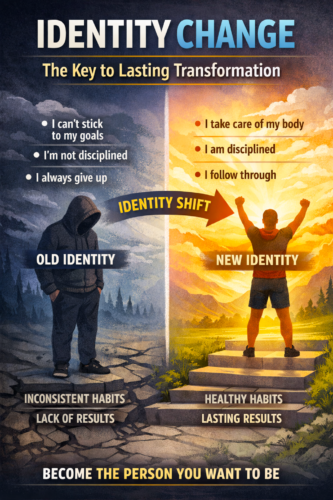
The reason is simple: you’re trying to change your actions without changing your identity. If, deep down, you still see yourself as someone who struggles with consistency or someone who always starts and stops, your behavior will eventually align with that belief. You may act differently for a while, but your subconscious will pull you back to what feels familiar and true to you. This creates a cycle of starting strong and falling off over and over again.
No matter how much motivation you have or how disciplined you try to be, those are temporary states. Your identity, on the other hand, is permanent—until you consciously change it. And in the long run, your identity will always win.
What Is an Identity Shift?
An identity shift is the process of redefining how you see yourself at your core because the way you perceive yourself ultimately shapes how you think, feel, act, and make decisions every day. Instead of telling yourself, “I want to get fit,” you begin to embody a new standard by saying, “I am someone who prioritizes my health.” This may seem like a small language change, but it creates a powerful internal shift.
When you start identifying as that person, your choices naturally begin to align with that belief. You move differently, think differently, and show up differently without relying solely on motivation or willpower. Rather than chasing outcomes, you anchor your actions in who you believe you are becoming. This is where real, lasting transformation happens: when your behaviors are no longer forced, but are simply a reflection of your identity.
Identity Drives Behavior -Not the Other Way Around
Most people believe that if you just change your behavior, your identity will eventually follow. But in reality, it works the opposite way; your identity shapes your behavior. The way you see yourself determines the choices you make on a daily basis. Your habits are not random; they are a direct reflection of who you believe you are.
If you identify as a healthy person, you naturally gravitate toward nourishing foods and consistent movement. If you see yourself as disciplined, you follow through on commitments without constantly negotiating with yourself. If you believe you are confident, you take action even when it feels uncomfortable. These behaviors don’t require constant motivation; they feel aligned with who you are.
When you shift your identity, your decisions begin to change automatically. The wanted “right” choices become part of your standard. Instead of forcing new habits, you embody them. This is what makes sustainable behavior change—when your actions are no longer something you have to think about, but simply an extension of who you’ve become.
The Three Levels of Change
To create lasting transformation, you need to understand the three levels of change:
1. Outcomes (Results)
To create lasting transformation, you need to understand the three levels of change, starting with outcomes, or results. These are the visible changes you’re likely aiming for, such as losing weight, having more energy, and improving your overall health. While these goals are motivating, they are just the surface level of change and don’t address what truly drives long-term success.
2. Processes (Habits)
The next level is processes, or habits: the daily actions that shape your results. This is where you focus on what you consistently do, such as your workouts, the way you fuel your body through nutrition, and the quality of your sleep. By improving these habits, you begin to build a foundation that supports lasting change.
3. Identity (Who You Are)
The deepest level is identity: who you believe you are. This is where lasting change truly takes root. When you start to see yourself as someone who takes care of your body, your choices naturally begin to align with that belief. Most people focus only on outcomes and processes, but it’s your identity that serves as the foundation for sustainable transformation.
The Science Behind Identity Shift
Lasting behavior change is deeply rooted in how your brain, beliefs, and self-perception interact. When you focus on identity, you’re not just changing what you do; you’re rewiring the internal systems that drive your decisions.
Your Brain Seeks Consistency With Your Identity
Your brain is wired to maintain consistency between your actions and your self-image. This concept, rooted in cognitive consistency theories, explains why you naturally gravitate toward behaviors that align with who you believe you are. If you identify as someone who is “fit and disciplined,” your choices (what you eat, how you move, how you recover) begin to reflect that identity. On the other hand, if your identity is tied to being “inconsistent” or “unmotivated,” your behaviors will unconsciously reinforce that belief.
Identity-Based Motivation Drives Action
Research in identity-based motivation shows that you’re far more likely to take action when a behavior feels aligned with your identity. When something feels like “this is who I am,” it requires less effort, less decision-making, and less reliance on willpower. This is why forcing habits without shifting identity often leads to burnout. You’re working against your internal wiring instead of with it.
Habits Stick When They Become Part of Who You Are
Behavioral science consistently shows that habits become more stable when they are tied to identity. It’s one thing to say, “I’m trying to work out,” and another to say, “I’m someone who trains regularly.” That subtle shift changes your level of commitment. When a behavior becomes part of your identity, skipping it feels like being out of alignment with yourself, not just missing a task.
Self-Perception Shapes Your Results
According to self-perception theory, you form beliefs about yourself by observing your own actions, and that includes the moments when you don’t follow through. Every time you say you’re going to do something and don’t, you send a signal to yourself that you’re inconsistent, unreliable, or someone who doesn’t achieve their goals. Over time, this creates a powerful feedback loop: you make a commitment, you break it, you interpret that as evidence of who you are, and that identity becomes stronger, making it even more likely that you’ll repeat the same pattern.
On the other hand, when you follow through, even in small ways, you begin to build evidence that you are consistent, disciplined, and capable. That’s why small, consistent wins matter so much. They don’t just move you closer to your goals. You reshape your identity into someone who does what they say they will do.
Rewiring Your Internal Narrative
Your identity is largely shaped by the stories you tell yourself. Research in narrative psychology shows that when you change your internal narrative, your behaviors begin to shift to match that story. Instead of repeating “I’ve always struggled with consistency,” say “I’m becoming someone who follows through.” This change in your internal dialogue begins to reinforce the change in your identity. Over time, your brain accepts this as your new baseline.
How to Create an Identity Shift
1. Decide Who You Want to Become
To create an identity shift, you first need to decide who you want to become. Get clear on your new identity by asking yourself: Who is the person that already has the results you want? Write it down. When you define this clearly, you begin to step into that version of yourself.
For example, you might start telling yourself, “I am someone who prioritizes my health daily,” or “I am disciplined and consistent.” These statements begin to shape how you think, act, and ultimately who you become.
2. Align Your Habits with That Identity
Align your habits with the identity you want to embody by listing the habits you need to start implementing. Every action you take is a vote for who you are becoming. When you choose a healthy meal, you reinforce your identity as a healthy person; when you skip a workout, you cast a vote for inconsistency. Over time, these small actions compound, strengthening and reinforcing your identity powerfully.
3. Eliminate Identity Conflicts
Another critical step is eliminating identity conflicts, because one of the biggest barriers to change is the internal battle between who you want to become and who you believe you are. You may want to be fit, but if you still identify as “someone who can’t lose weight” or “unmotivated,” your actions will continue to reflect that self-image. You simply cannot outperform how you see yourself.
To truly shift, you need to replace limiting beliefs, become aware of your internal dialogue, identify cognitive distortions, change your mindset, and stop reinforcing the old patterns that keep you stuck.
4. Use Repetition to Reinforce Identity
To reinforce your identity, you need repetition. Your identity is built through consistent evidence, meaning every action you take either strengthens or weakens who you believe you are. The more you act in alignment with your new identity, the stronger it becomes. That’s why small, consistent actions are far more powerful than occasional extreme efforts; they continuously prove to yourself who you are becoming.
5. Focus on Being, Not Just Doing
Instead of only focusing on what you need to do, shift your attention to who you need to become. Most people stay stuck asking, “What do I need to do?” but real transformation happens when you start asking, “Who do I need to become?” When you make that shift at the identity level, your behaviors no longer feel forced—they begin to flow naturally from who you believe you are.
To fully step into your new identity, you must embody the emotional state and energetic presence of the person you are becoming by feeling, thinking, and showing up as them before it fully materializes. A powerful habit that helps rewire your brain and reinforce your new identity is practicing Joe Dispenza’s meditation or heart coherence meditation.
6. Avoid Common Mistakes
When you’re trying to create sustainable behavior change, there are a few common mistakes you need to avoid:
- Avoid focusing only on goals without addressing your identity; you’ll likely struggle to sustain results
- Refrain from trying to change too many habits at once; you can overwhelm yourself and lose consistency
- Avoid holding onto old self-beliefs—like telling yourself you’re not disciplined or that you always fall off track. These will keep you stuck in the same patterns.
- Don’t rely on motivation, or you’ll find yourself starting and stopping over and over again instead of creating real, lasting transformation. Instead, build an identity that supports your actions.
Conclusion: Become the Person First
Sustainable change doesn’t come from doing more. It comes from becoming someone different. When you shift your identity, everything else begins to align. Your habits become easier to maintain, your choices feel more natural, and your results become a byproduct of who you are, not something you constantly have to chase. Start with identity before goals. Ask yourself: Who do I need to become to live the life I want? Then begin proving that identity to yourself through small, consistent actions. Every time you follow through, you reinforce that new version of you. You don’t need more motivation; you need alignment. Because when your actions match your identity, success is no longer something you force… It’s something you live.
FAQs: Identity Shift & Behavior Change
Identity-based behavior change is the process of transforming your habits by first changing how you see yourself. Instead of focusing only on actions, you focus on becoming the type of person who naturally performs those actions.
Most people focus on goals and short-term motivation rather than identity. Without shifting how you see yourself, your old patterns eventually resurface, causing you to fall back into previous behaviors.
You start by deciding who you want to become and then reinforcing that identity through small, consistent actions. Every time you follow through, you provide evidence that supports your new identity.
There’s no fixed timeline, but identity shifts happen gradually through repeated behaviors. The more consistently you act in alignment with your desired identity, the faster it becomes your new default.
Yes. Your past actions don’t define your future identity. What matters is the evidence you create moving forward. Each new action is an opportunity to reinforce a different version of yourself.
Mindset is a key part of identity. The beliefs you hold about yourself influence your actions, and your actions reinforce those beliefs. Shifting your mindset helps break negative cycles and supports new behaviors.
Motivation is temporary, but consistency builds identity. When you consistently take action, even in small ways, you reinforce the belief that you are someone who follows through.
The biggest mistake is trying to change behaviors without changing identity. This creates a constant internal struggle, where your actions don’t match how you see yourself, making change harder to sustain.
To a Fitter Healthier You,
Mind-Body Optimization Specialist
About the Author
Adriana Albritton is a Mind-Body Optimization Specialist and the founder of FitnAll Coaching. She developed the FITNALL Method, a holistic framework that integrates fitness, internal health, thought patterns, nutrition, adaptation, longevity, and lifestyle habits to support sustainable fat loss and long-term wellness. Adriana is the author of 28 Days to a New Life: A Holistic Program to Get Fit, Delay Aging, and Enhance Your Mindset. She speaks and writes about holistic performance, longevity, and the integration of mind and body for optimal health.