
Many people try to improve their lives by relying on motivation or willpower. They start exercising, eating better, waking up earlier, or practicing mindfulness—only to abandon these goals weeks later. This is why most New Year’s resolutions don’t last. The problem is not a lack of discipline. The problem is a lack of understanding about how habits actually form in the brain. Sustainable behavior change happens when habits become automatic. When a behavior becomes a habit, it requires far less mental effort and becomes part of your identity. Once you understand the science of habit formation, you’ll know how to build habits that stick naturally rather than relying on constant motivation.
The Neuroscience of Habit Formation
Habits may feel like simple routines, but they are deeply rooted in the brain’s neurological wiring. Understanding the neuroscience behind habit formation helps explain why certain behaviors become automatic while others require constant effort.
At the center of habit formation is a brain structure called the basal ganglia. This region plays a key role in learning, routine behaviors, and automatic actions. When you repeatedly perform the same behavior, the basal ganglia begin to store that action as a pattern. Over time, the brain shifts the behavior from conscious decision-making to an automatic response.
This shift is important because the brain is designed to conserve energy. Rather than analyzing every decision throughout the day, the brain creates shortcuts—habits—that allow you to perform common behaviors with minimal mental effort. The same process takes place in unhealthy habits.
Another critical component of habit formation involves the brain’s dopamine system. Dopamine is a neurotransmitter associated with motivation, reward, and reinforcement. When a behavior produces a positive outcome—such as improved mood after exercise or satisfaction after completing a task—the brain releases dopamine. This reinforces the behavior and encourages the brain to repeat it in the future.
Over time, the brain begins to anticipate the reward even before the behavior occurs. This anticipation strengthens the connection between the trigger and the action, which is why certain habits can feel automatic or even compulsive.
The Habit Loop
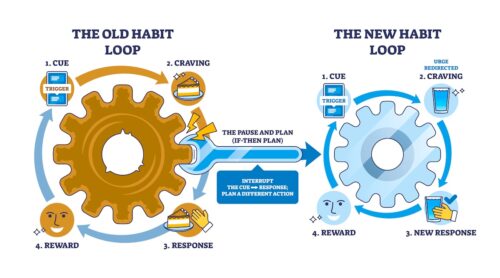
Habit formation also involves a neurological pattern known as the cue–routine–reward loop.
The process typically follows three steps: Cue → Behavior → Reward
- Cue (Trigger): A signal that tells the brain to initiate a behavior. This could be a time of day, a location, an emotional state, or an action.
- Routine (Behavior): The action you perform, such as exercising, eating a snack, or checking your phone.
- Reward: The benefit your brain receives after completing the behavior. This reward reinforces the loop and encourages repetition.
For example, a simple habit loop might begin with a cue, such as seeing your gym bag. This visual trigger reminds your brain that it is time to perform a specific behavior, in this case exercising. After completing the workout, your body experiences a reward—the release of endorphins and increased energy—which reinforces the behavior and makes your brain more likely to repeat it in the future.
As this loop repeats, the neural pathways associated with the habit become stronger through a process called neuroplasticity. It refers to the brain’s ability to reorganize and strengthen connections based on repeated behaviors and experiences.
This means that every time you perform a habit, you are literally strengthening the neural circuitry that supports that behavior. The opposite is also true. When a habit is not reinforced, the neural pathways gradually weaken. This is why breaking bad habits often requires replacing them with new behaviors that provide a similar reward.
Physical health also influences the brain’s ability to form habits. Factors such as sleep quality, nutrition, stress levels, and exercise all affect brain chemistry and cognitive function. Chronic stress, poor sleep, and blood sugar instability can impair decision-making and reduce self-regulation, making habit formation more difficult.
This is one reason why sustainable behavior change often requires a holistic approach that aligns physiology, mindset, and lifestyle systems. When the brain is supported through proper nutrition, physical activity, mental clarity, and identity-based thinking, the neurological processes that drive habit formation become significantly more effective.
In essence, habits are not based on willpower. They are the result of training the brain through consistent repetition and supportive biological conditions. The more consistently a behavior is repeated, the more deeply it becomes wired into the brain—eventually transforming deliberate actions into automatic routines that shape daily life.
Tiny Habits: Why Small Changes Lead to Big Results
One of the most powerful principles in habit formation is the concept of Tiny Habits. The idea is simple: instead of trying to make dramatic lifestyle changes overnight, you start with very small behaviors that are easy to repeat consistently. Tiny habits remove the psychological resistance that often causes people to quit.
For example, instead of committing to a one-hour workout every day, you might start with:
• 5 push-ups
• 3 minutes of stretching
• a short walk after dinner
These actions may seem insignificant, but they trigger something important in the brain: consistency. Over time, tiny habits naturally grow into larger behaviors. Someone who begins with five push-ups may gradually increase to full workouts because the behavior already feels familiar and automatic.
This is why small actions often outperform ambitious goals. Large goals can feel overwhelming, while tiny habits are almost impossible to fail. In many cases, transformation does not come from radical change. It comes from small behaviors repeated consistently.
Why Most People Fail to Build Habits
Many attempts at building new habits fail because people rely heavily on motivation instead of creating systems that support consistent behavior. Motivation can be powerful in the short term, but it tends to fluctuate based on mood, energy levels, and life circumstances. When motivation fades—as it often does—people frequently abandon the habits they initially set out to build. This is why many individuals start strong with new routines only to lose consistency after a few weeks.
Another common reason habits fail is that people try to change too many behaviors at once. Attempting to overhaul multiple areas of life simultaneously can quickly become overwhelming, making it difficult to sustain long-term progress. Unrealistic expectations also play a role. When people set goals that are too ambitious or demanding from the beginning, the gap between their current behavior and their desired outcome can feel discouraging.
Habits also tend to fail when they are not connected to existing routines. Without a clear trigger or cue, new behaviors can be easily forgotten or pushed aside by daily responsibilities. In addition, many individuals rely almost entirely on willpower to maintain habits. While willpower can help initiate change, it is not a reliable long-term strategy because it becomes depleted over time.
Finally, emotional and psychological barriers are often overlooked. Stress, limiting beliefs, cognitive distortions, and unresolved mental patterns can quietly sabotage consistency. For lasting habit formation to occur, behavior change must be supported by both practical systems and internal alignment. This is how to build habits that last.
6 Practical Steps to Build Habits That Stick
1. Start Small
One of the most effective strategies is to build habits is by starting small. When a habit feels effortless, you are far more likely to repeat it daily. Small habits reduce resistance and make it easier for the brain to accept the new behavior. Over time, these tiny actions build momentum and naturally expand into larger lifestyle changes.
For instance, instead of committing to an intense routine immediately, begin with simple actions such as five minutes of stretching, ten push-ups, or preparing one healthy meal.
2. Anchor Habits to Existing Routines
Anchoring new habits to existing routines, often called habit stacking, is another powerful technique on how to build habits. This involves attaching a new behavior to something you already do regularly. Because the original habit already exists, the brain begins to associate the new behavior with that established trigger. This strengthens the cue-behavior connection and significantly improves consistency.
For example, you might meditate immediately after brushing your teeth or perform a short stretch routine after your morning coffee.
3. Remove Friction
It is also important to remove friction and design your environment to support your habits. Habits thrive in structured environments where positive behaviors are easy to perform. Successful people often create systems that make healthy actions almost automatic.
For example, scheduling workouts in advance, removing junk food from the home, or establishing a consistent sleep routine can support long-term behavioral change. Small environmental adjustments—such as keeping workout clothes visible, preparing healthy meals in advance, or setting reminders—reduce barriers and make habits easier to maintain.
4. Address Limiting Beliefs
Another key step is to address limiting beliefs that may be undermining your progress. Many people struggle with internal narratives such as “I’m not disciplined” or “I always quit.” These beliefs create psychological resistance and often lead to self-sabotage.
Reframing these thought patterns is essential for long-term habit formation. When individuals challenge these beliefs and replace them with empowering perspectives, they create a mental grounds that supports consistent action
5. Reinforce Identity
Another powerful driver of lasting change is identity reinforcement. When habits align with how you see yourself, they become far easier to maintain. Instead of saying, “I’m trying to work out,” shift your mindset to “I am someone who trains regularly.”
Identity-based habits reshape behavior because they reflect who you believe you are. A helpful question to ask yourself each day is: What would the healthiest version of me do today? When actions align with identity, habits become natural rather than forced.
6. Track Progress
Finally, it is helpful to track your progress. Monitoring behaviors creates accountability and provides motivation as you see your consistency grow over time. Habit trackers, journals, and digital apps can reinforce positive behaviors by making progress visible. This simple practice strengthens commitment and helps ensure that small daily actions accumulate into lasting behavior change.
Conclusion: Lasting Habits Are Built, Not Forced
Relying on bursts of motivation or pushing yourself through sheer willpower is not how to build habits that last. Sustainable change happens when behaviors are designed in a way that works with the brain rather than against it. By understanding how habits form through cues, repetition, rewards, and neuroplasticity, you can intentionally create routines that gradually become automatic.
Whether it’s exercising regularly, eating healthier, or cultivating a more focused mindset, transformation happens through small, repeated actions practiced over time—especially when supported by a structured environment and healthy mindset. By building systems that support your habits, you can create meaningful changes that improve your health, productivity, and overall quality of life for the long term.
To a Fitter Healthier You,
Mind-Body Optimization Specialist
About the Author
Adriana Albritton is a Mind-Body Optimization Specialist and founder of FitnAll Coaching. She developed the FITNALL Method, a holistic framework that integrates fitness, internal health, thought patterns, nutrition, adaptation, longevity, and lifestyle habits to support sustainable fat loss and long-term wellness. Adriana is the author of 28 Days to a New Life: A Holistic Program to Get Fit, Delay Aging, and Enhance Your Mindset. She speaks and writes about holistic performance, longevity, and the integration of mind and body for optimal health.